


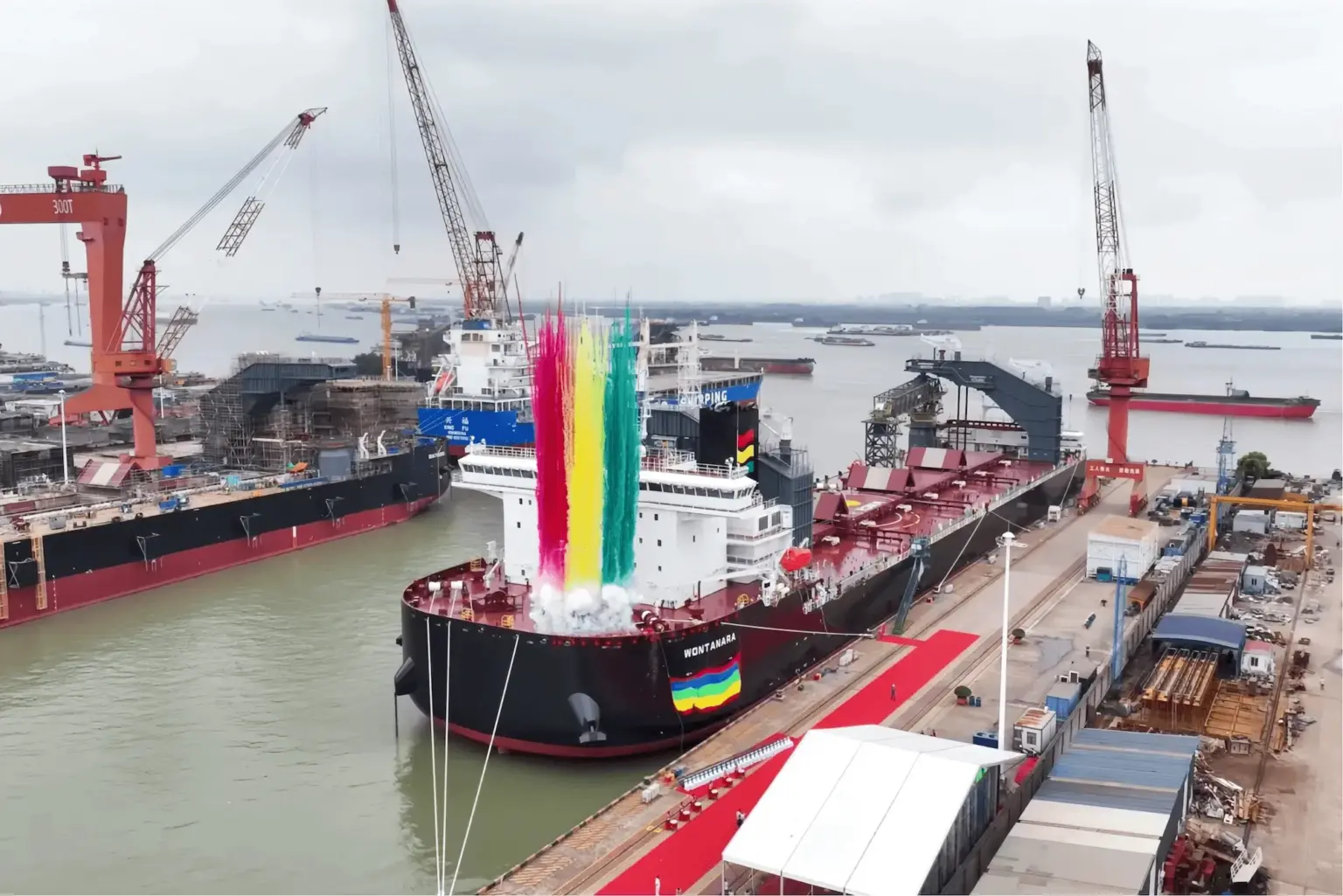
The naming of Wontanara, SimFer's first transhipment vessel (TSV), marks far more than a ceremonial milestone for Simandou iron ore project. It represents the operational transition from infrastructure construction to the development of an integrated export logistics system capable of supporting one of the world's largest new iron ore operations.
Officially named during a ceremony in Yangzhou, China, the 215-metre vessel will now sail to Guinea carrying the first cohort of SimFer's Guinean seafarer trainees. Once commissioned at the Port of Morebaya, Wontanara will become the first of five purpose-built transhipment vessels designed to move iron ore from the shallow-water port to deep-water ocean-going bulk carriers offshore.
The vessel is jointly owned through SimFer—the partnership between the Government of Guinea, Rio Tinto and the Chinalco-led CIOH Consortium—and represents another major piece of the extensive logistics network being built to unlock the vast Simandou iron ore deposits.
Named after the Susu word meaning "we are together," Wontanara symbolises the collaborative nature of the Simandou project, bringing together Guinean institutions, international mining companies, shipbuilders and maritime specialists to deliver one of Africa's most ambitious mining developments.
Engineering Designed for Simandou
Unlike conventional bulk carriers, Wontanara has been specifically engineered for Guinea's coastal conditions.
Each TSV will transport more than 40,000 tonnes of iron ore from Morebaya to offshore export vessels while operating in shallow waters. Its self-unloading technology is capable of transferring ore at more than 12,000 tonnes per hour, a loading rate believed to be among the fastest in the world. Five independent thrusters allow the vessel to manoeuvre without tug assistance, reducing operational complexity and improving turnaround times.
These design features are particularly significant because Simandou's export strategy relies on efficient transhipment rather than constructing a traditional deep-water loading terminal. As production ramps up, vessel productivity will become a key determinant of export capacity, making the TSV fleet an essential component of the project's overall economics.
Maritime Capacity Building Takes Centre Stage
Beyond its engineering specifications, Wontanara highlights another important aspect of SimFer's localisation strategy.
The vessel will arrive in Guinea with the first group of Guinean seafarers trained in China through the Quanzhou Ocean Institute under a programme supported by COSCO Shipping. Their deployment aboard the vessel represents one of the first tangible examples of specialised maritime skills transfer linked directly to the Simandou project.
For Guinea, whose mining workforce has traditionally focused on exploration, extraction and processing, the development of domestic maritime expertise opens opportunities well beyond Simandou itself. As mineral exports continue to grow, demand for skilled marine professionals, port operators and logistics specialists is expected to increase significantly.
The choice of Néné Hawa Baldé, a SimFer employee at Morebaya Port, as the vessel's godmother also reflects the project's emphasis on recognising Guinean talent and strengthening local participation across the mining value chain.
A Strategic Milestone for Guinea's Mining Logistics
For mining investors and industry observers, the arrival of Wontanara is another indication that the Simandou project continues to advance toward operational readiness.
While public attention has largely focused on the construction of the 600-kilometre trans-Guinean railway and the mine itself, the maritime export system is equally critical. Without efficient port operations and reliable offshore loading capacity, large-scale iron ore production cannot reach international markets.
The deployment of five specialised transhipment vessels demonstrates that SimFer is addressing this final link in the logistics chain well ahead of full production.
It also reflects a broader trend emerging across Guinea's mining sector: investment is increasingly extending beyond extraction into integrated infrastructure, logistics, skills development and long-term industrial capability.
As Wontanara begins its voyage to Guinea, it carries more than equipment and trainees. It carries a clear signal that Simandou's export infrastructure is steadily taking shape, bringing Guinea closer to becoming one of the world's leading suppliers of high-grade iron ore while simultaneously building the maritime expertise needed to support that ambition for decades to come.
Share on social media

-