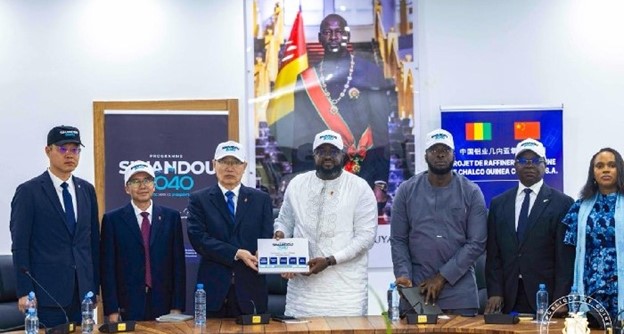
Guinea has taken another significant step toward building a domestic mineral processing industry following the signing of agreements for the construction of a major alumina refinery in Boffa by Chalco Guinea Company, reinforcing the country’s long-term strategy to move beyond raw bauxite exports and increase value addition within its mining sector.
The project, announced during an official ceremony attended by senior government officials and industrial partners, forms part of the broader Sino-Guinean cooperation framework strengthened during the 2026 Forum on China-Africa Cooperation (FOCAC) discussions between President Mamadi Doumbouya and Xi Jinping.
The agreement was presided over by Djiba Diakité, who also chairs the Strategic Committee for the Simandou Program, alongside Amara Camara. The signing underscores Guinea’s increasing emphasis on industrialization and domestic transformation of mineral resources.
A New Processing Hub in Guinea’s Bauxite Value Chain
The proposed refinery will have an annual production capacity of 1.2 million tonnes of alumina, requiring an estimated US$1.68 billion investment, including approximately US$1.12 billion dedicated to refining infrastructure.
Once operational, the facility will become Guinea’s third alumina refinery project, joining the pipeline of downstream developments that includes the refinery promoted by SPIC, expected to enter service in 2027, and the Winning Consortium Alumina Guinea refinery planned for 2028.
For Guinea—home to the world’s largest known reserves of bauxite—the expansion of refining capacity represents a structural shift in mining policy. Historically, the country has exported raw ore while higher-value processing occurred overseas, particularly in Asia. Increasing domestic alumina production could improve export revenues, create industrial employment and reduce dependence on unprocessed commodity exports.
Human Capital Development Embedded in Mining Investment
Beyond industrial infrastructure, the Chalco project includes notable commitments to skills development and local content, areas that have become increasingly central to Guinea’s mining agreements.
According to project details, the initiative will provide:
- 500 scholarships over 20 years focused on technical and industrial disciplines;
- The establishment of an engineering and technical training school in Guinea, designed to host approximately 100 students per specialization annually over a ten-year period;
- Local content mechanisms aimed at strengthening youth employment, skills transfer and national workforce capacity.
These provisions suggest a broader objective of developing a domestic technical workforce capable of supporting Guinea’s emerging processing and manufacturing industries.
Simandou 2040 Vision Gains Momentum
The refinery aligns with the government’s Simandou 2040 Program, a national industrialization strategy targeting the construction of five alumina refineries by 2030. With three projects now reportedly underway, Guinea appears to be accelerating implementation of its downstream mining agenda.
For mining investors and industry stakeholders, the Chalco agreement signals continued policy support for beneficiation, local processing and industrial diversification. If delivered on schedule, these projects could reshape Guinea’s position in the global aluminum value chain—from a dominant bauxite exporter to a more integrated producer of processed mineral products.
The challenge ahead will be execution: financing, infrastructure delivery, energy availability and workforce readiness will determine whether Guinea’s refining ambitions translate into sustainable industrial transformation.