


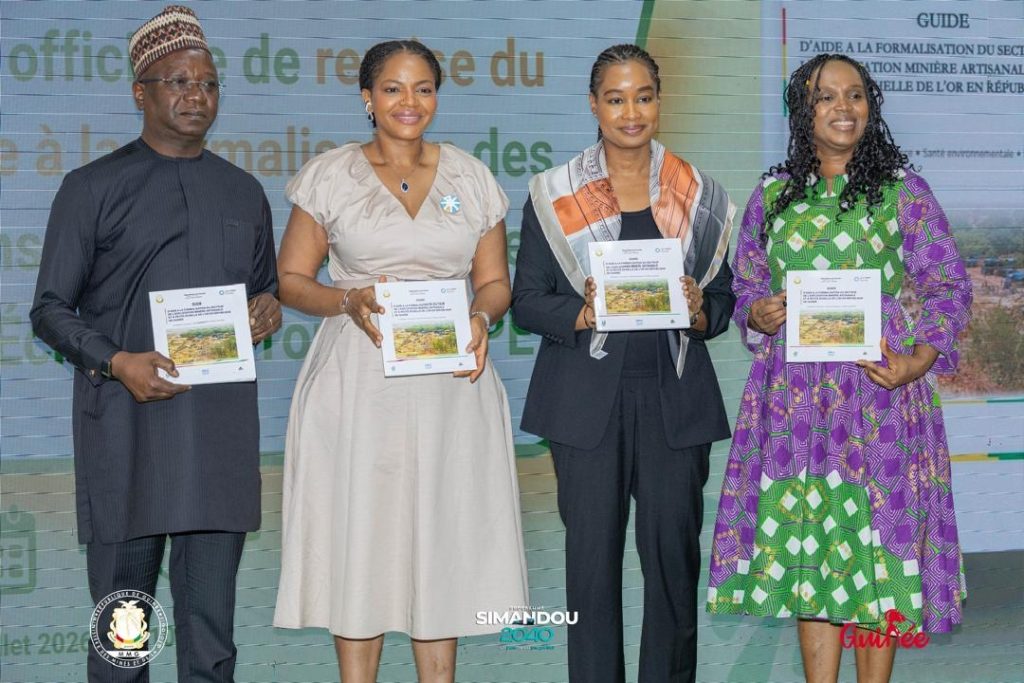
Conakry — Guinea has taken another significant step toward transforming its artisanal and small-scale gold mining (ASGM) sector with the official launch of the Guide to the Formalization of Artisanal and Small-Scale Gold Mining (ASGM). Developed under the planetGOLD Guinea project with support from the Global Environment Facility (GEF) and implemented by the United Nations Environment Programme (UNEP) and the African Centre for Environmental Health (CASE), the guide is designed to help artisanal miners, cooperatives and government institutions navigate the country's formal mining framework.
The guide was officially presented on 1 July in Conakry during a ceremony co-chaired by Minister of Mines and Geology Bouna Sylla and attended by senior government officials, technical and financial partners, civil society representatives and mining stakeholders.
The publication comes at a time when Guinea is intensifying reforms to modernize the ASGM sector as part of the country's broader natural resource governance agenda and the Simandou 2040 development vision. It provides practical guidance on licensing procedures, legal obligations, environmental and social standards, financing opportunities, and the establishment of mining cooperatives.
Government officials described the guide as more than a reference document. It is intended to serve as a roadmap for transitioning thousands of informal miners into a regulated mining economy that improves safety, environmental performance, traceability and access to financial services.
Artisanal mining remains an important source of employment and income across Guinea's gold-producing regions, particularly in Siguiri, Mandiana, Kouroussa and Dinguiraye. However, the sector continues to face persistent challenges, including widespread informality, unsafe mining practices, child labour, mercury use, environmental degradation, illegal occupation of mining concessions and poor site rehabilitation.
The government has already initiated several complementary reforms, including the identification of dedicated artisanal mining corridors, digitalization of mining plots, strengthened inspection mechanisms, environmental compliance requirements and the promotion of cooperatives. Authorities are also encouraging the development of small-scale gold processing facilities and greater domestic value addition through the recently commissioned gold refinery in Gbessia.
The new guide has the potential to become an important catalyst for these reforms. By clearly explaining administrative procedures and regulatory requirements, it can reduce uncertainty for miners seeking legal status while improving communication between miners, regulators and local authorities.
Nevertheless, the guide's effectiveness will ultimately depend on its accessibility to its primary audience.
A large proportion of Guinea's artisanal miners have limited literacy or are unable to read lengthy technical documents. For many operators, particularly those working in remote mining camps, a printed manual alone is unlikely to change existing practices. Formalization requires not only information but also understanding, trust and sustained engagement.
To maximize the guide's impact, authorities and development partners will need to complement the publication with an extensive field-based awareness campaign. Training workshops should be organized directly within mining communities using local languages such as Malinké, Pular and Soussou, supported by practical demonstrations rather than classroom-style presentations.
The guide should also be adapted into simplified versions using illustrations, diagrams, infographics and pictograms that explain key procedures regardless of literacy level. Short instructional videos, community radio programmes and mobile awareness campaigns could significantly extend its reach among mining communities.
Equally important is the involvement of local mining cooperatives, traditional leaders, women's associations and youth groups, who are often the most trusted intermediaries within artisanal mining areas. Training selected miners as peer educators would help disseminate best practices more effectively than relying solely on government officials.
Formalization efforts must also be accompanied by tangible incentives. Simplified licensing procedures, easier access to finance, technical assistance, mercury-free processing technologies and reliable gold marketing channels will encourage miners to join the formal economy. Without visible economic benefits, many operators may continue to view formalization as an administrative burden rather than a business opportunity.
Guinea's new ASGM formalization guide represents a well-conceived policy instrument that aligns with international commitments under the Minamata Convention while supporting the country's ambition to build a safer, more responsible and economically productive artisanal mining sector. However, its success will not be measured by the number of copies distributed, but by its ability to change practices on the ground. Effective implementation will require continuous outreach, practical training and sustained collaboration between government, development partners and mining communities to ensure that the guide becomes a living tool rather than simply another policy document.
Share on social media

-