


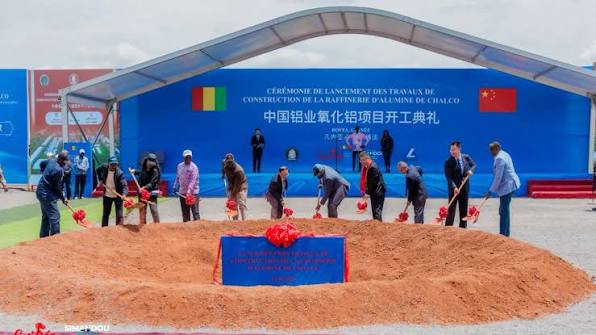
Guinea is moving aggressively to transform its position as the world’s leading bauxite producer into a broader mineral-processing economy. The government is targeting five alumina refineries by 2030, with combined production capacity of around 7 million to 8 million tonnes per year. Three refineries are already under construction, while aluminium smelting is envisaged as the next stage of the value chain.
For Guinea, the strategic rationale is clear. The country has built a globally significant bauxite mining industry, but much of the economic value generated from its resources remains outside the country because of limited domestic processing. The proposed refinery programme therefore represents more than an industrial expansion: it is an attempt to reposition Guinea from a major raw-material exporter into a competitive mineral-processing hub.
The central question, however, is whether Guinea can build the infrastructure and investment environment required to make five refineries commercially sustainable.
Power is the critical constraint
Energy has emerged as the most immediate barrier to Guinea’s industrialisation ambitions. The country currently generates approximately 1,000 MW, largely from hydropower, while the government estimates that industrialisation could require between 5,000 MW and 10,000 MW.
The problem is not simply installed generation capacity. Industrial projects require reliable, predictable and competitively priced electricity. Guinea’s hydropower system is exposed to seasonal fluctuations: during the rainy season, the country can export electricity to neighbouring markets, while during the dry season it imports power from countries including Côte d’Ivoire and Senegal.
This creates a fundamental challenge for energy-intensive industries. Alumina refining requires substantial industrial energy, while primary aluminium smelting is even more dependent on uninterrupted electricity. A power system that is adequate for mining and seasonal exports may not be adequate for a large-scale industrial cluster operating continuously throughout the year.
The experience of other African mineral producers provides a warning. In South Africa, rising electricity costs have contributed to the closure of most of the country's ferrochrome smelters, while South32’s Mozal aluminium smelter in Mozambique was placed on care and maintenance in 2026 following difficulties surrounding its electricity supply and drought-related pressure on hydropower.
The lesson for Guinea is straightforward: building refining capacity before securing its energy foundation could create stranded industrial assets.
Guinea needs an integrated industrial strategy
The debate should therefore move beyond the question of whether Guinea can build five refineries. The more important question is whether the country can create an integrated industrial ecosystem in which refineries, mines, power plants, ports, railways, logistics providers and downstream consumers reinforce one another.
Investors are looking for more than access to bauxite. At African Mining Week, Egypt’s Deputy Minister for Strategic Industries Mohamed Zada identified four requirements: reliable feedstock, affordable and dependable power, stable government policy and committed buyers. These conditions, he argued, must be addressed simultaneously.
This framework is particularly relevant to Guinea. The country already has a major advantage in the first pillar: feedstock. Its enormous bauxite resources provide the foundation for a large refining industry. The challenge is to build the other three pillars around that resource advantage.
What should Guinea do?
First, Guinea should develop a dedicated industrial power strategy for the mining and refining sector. Hydropower should remain an important component of the energy mix, but the government should avoid excessive dependence on a single source vulnerable to seasonal and climatic conditions. Gas, solar, thermal generation, regional power imports and potentially other technologies should be evaluated according to cost, reliability, environmental performance and scalability.
Second, the government should establish long-term power arrangements for strategic industrial projects. Refinery and smelter investors need visibility over electricity prices and availability over the life of their investments. Power contracts should therefore be structured around predictable tariffs, firm supply commitments and mechanisms for managing seasonal risks.
Third, Guinea should accelerate investment in transmission and industrial infrastructure. Additional generation alone will not solve the problem if electricity cannot reliably reach mining and processing centres. Railways, ports, water infrastructure and industrial zones must be planned alongside power generation rather than as separate projects.
Fourth, the government should adopt a phased downstream-development model. The five-refinery objective can remain a strategic target, but project approvals should be closely linked to demonstrated power availability, financing, infrastructure readiness and market commitments. This would reduce the risk of encouraging capacity that cannot operate competitively.
Finally, Guinea should deepen engagement with development-finance institutions and strategic investors. The US International Development Finance Corporation and the Africa Finance Corporation are already supporting mineral-processing projects in Africa, demonstrating that financing channels exist for credible downstream projects.
From resource advantage to industrial competitiveness
Guinea has a rare combination of world-class bauxite resources, rapidly expanding mining production and a clear political ambition to increase domestic value addition. But resources alone do not create a competitive refining industry.
The five-refinery target will ultimately be judged not by the number of projects announced or constructed, but by the number that can operate reliably, competitively and profitably.
For Guinea, the immediate priority should therefore be to close the infrastructure and energy gap while maintaining a stable investment framework. If the country succeeds in aligning bauxite supply, reliable power, transport infrastructure, policy certainty and long-term buyers, its refining ambitions could become the foundation of a much broader industrial transformation.
The strategic opportunity is significant. But the next phase of Guinea’s mining story will be determined not simply by how much bauxite the country can produce, but by how effectively it can convert that resource advantage into competitive, bankable and sustainable downstream capacity.
Share on social media

-