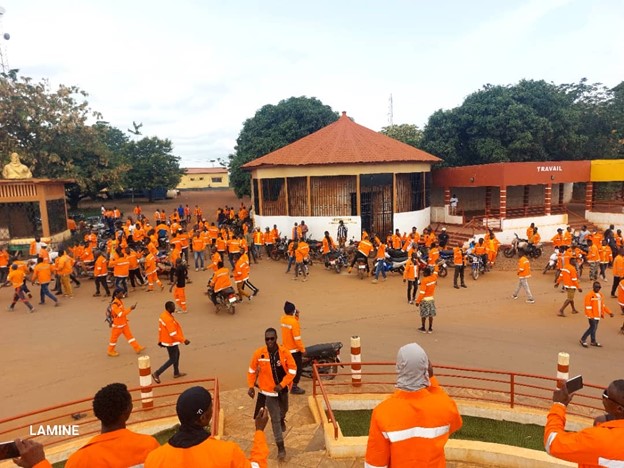
Mining operations have resumed at the northern blocks of Guinea’s flagship Simandou iron ore project following the suspension of a strike that had disrupted production activities for more than a week at the Baowu Winning Consortium Simandou (WCS).
The work stoppage, which began on 28 April, affected mining operations at Blocks 1 and 2 of the Simandou deposit, operated by the Chinese-led consortium headed by Baowu Resources. Approximately 3,000 workers reportedly participated in the strike, demanding improved labour conditions and full implementation of Guinea’s newly introduced mining sector wage framework.
According to an agreement reached on Wednesday between company management, labour unions, and Guinean authorities from the ministries of labour and mines, employees agreed to return to work immediately while negotiations continue on outstanding employment classification issues.
Under the deal, WCS committed to implementing the national collective agreement for Guinea’s mining sector signed in February 2025. The company also agreed to preserve existing employee benefits and introduce fixed salary increases across several job categories.
The dispute highlighted growing labour expectations in Guinea’s mining industry as the government seeks to standardise employment conditions across major mining operations. Workers at WCS had argued that the consortium had not fully aligned compensation structures with the national framework introduced this year to harmonise wages within the sector.
The strike brought key mining activities — including blasting, loading, hauling and dumping — to a standstill, although rail and port logistics reportedly continued during the disruption. Industry observers noted that the interruption posed operational risks for one of the world’s most strategically important iron ore developments.
A consultant involved in the project described the situation as having a “direct impact on production,” underlining the importance of a rapid resolution given Simandou’s significance to global iron ore supply chains.
The labour dispute also underscored comparisons between employment conditions at WCS and those offered at Simfer, the joint venture operating Simandou’s southern Blocks 3 and 4. Simfer is jointly owned by Rio Tinto, Chinalco and the Guinean state. Workers at the northern blocks reportedly sought compensation parity with employees working on the Simfer side of the project.
Further negotiations supervised by Guinea’s labour inspectorate are expected to continue until 20 May to address unresolved job classification matters and ensure full compliance with the country’s labour regulations governing the mining industry.
Simandou is widely regarded as the world’s largest untapped high-grade iron ore deposit and remains central to Guinea’s long-term mining development strategy. The project is expected to play a transformative role in the country’s economy through export revenues, infrastructure development and local employment generation.
After decades of delays linked to infrastructure, financing and ownership disputes, exports from Simandou began in late 2025. At full capacity, the integrated project is expected to produce up to 120 million tonnes of iron ore annually, positioning Guinea among the world’s leading iron ore exporters.
The temporary disruption also comes at a critical stage in the project’s transition from construction to sustained production. WCS, which employed more than 10,000 workers during the construction phase, has been progressively adjusting its workforce as operational activities ramp up.
For Guinea’s mining sector, the resolution of the dispute may signal a broader shift toward stronger labour oversight and stricter enforcement of sector-wide employment standards. As Simandou advances toward full-scale production, labour stability and effective stakeholder engagement are likely to remain essential to maintaining operational continuity across one of Africa’s most ambitious mining developments.