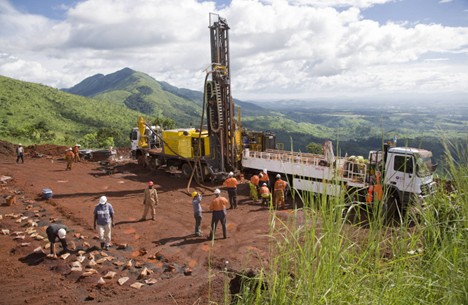
Rio Tinto's presence in Guinea centers on the landmark Simandou iron ore project, one of the most significant mining developments in the world. The first quarter of 2026 marked a period of both meaningful progress and sobering challenges for this operation.
Production Performance
Simandou recorded mine gate production of 0.6 Mt (100% SimFer basis) during Q1 2026, representing Rio Tinto's 257,000 wet metric tonne equity share. It is worth noting that this production figure reflects crushed ore stockpiled at the SimFer mine gate ahead of rail loading — final tertiary crushing only takes place after the ore reaches China, meaning this output is not yet classified as saleable production. As at the end of Q1, some 2.1 Mt (100% basis) of crushed ore had been stockpiled at the mine gate, ready for loading onto the rail network.
On the sales side, no Simandou sales were recorded within the quarter itself, a direct consequence of the approximately two-to-three month lag inherent in the supply chain — encompassing rail transport to Guinea's coast, ocean shipping to China, tertiary crushing, and final customer collection. However, 0.6 Mt (100% basis) was shipped to China during the quarter, with first sales subsequently realised in April 2026, a milestone that marks a commercially meaningful turning point for the project.
Safety Incident and Operational Disruption
The quarter was significantly overshadowed by a tragic fatality at the Simandou project, which occurred in February 2026. Following the incident, mine operations were immediately suspended and only progressively resumed over the course of approximately one month. Rio Tinto CEO Simon Trott acknowledged the loss directly in his opening remarks, describing it as a stark reminder of the company's foundational commitment to ensuring every worker returns home safely. The human cost and the subsequent suspension inevitably constrained the quarter's production output.
Infrastructure Milestones
Despite the operational setback, infrastructure progress at Simandou continued at a notable pace. The SimFer rail spur, connecting the mining concession to the shared main rail line, was confirmed as mechanically complete and fully commissioned during Q1 2026. Commissioning of the broader common rail infrastructure was also completed in the quarter, a landmark achievement for a project of this complexity and geographic remoteness.
Construction of the SimFer port facility is advancing ahead of plan, reaching 78% completion by quarter end. Three port ship loaders have been delivered and unloaded on site, and fabrication of the transhipment vessels is progressing, with fit-out works having commenced. Full port commissioning is expected in Q1 2027. Permanent crushing facilities at the mine itself — currently operating through temporary crushers — are expected to come online in H2 2026, on schedule. Overall, the SimFer mine is 74% complete.
The project's workforce stood at 20,700 people at quarter end, with a notable 77% Guinean participation rate, underscoring the project's significance to the local economy.
Ramp-Up Trajectory and Capital
Rio Tinto's total equity investment in Simandou stands at $6.2 billion. The project is targeting a 30-month ramp-up to full production rates from H2 2028, with the mine designed for an annualised capacity of 60 Mtpa (27 Mtpa Rio Tinto share). The high-grade nature of Simandou ore — its first full SimFer shipment was successfully delivered to China during the quarter — is expected to command a premium in the seaborne iron ore market.
In summary, Q1 2026 was a quarter of consolidation and infrastructure completion at Simandou. The tragic fatality and resulting suspension tempered near-term output, but the commissioning of key rail infrastructure and the achievement of first sales signal that Guinea is on the cusp of becoming a meaningful contributor to Rio Tinto's iron ore portfolio.