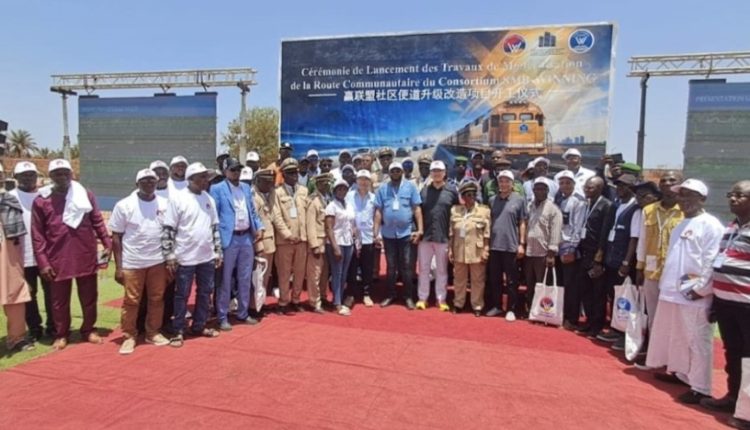
SMB-Winning Consortium has officially launched construction works on a 112-kilometre paved community road in the Boké mining corridor, marking another major infrastructure investment linked to Guinea’s fast-growing bauxite sector. The project, announced on May 7 in Kamikolo district, Kolaboui sub-prefecture, is expected to improve connectivity for nearly 100 villages and more than 40,000 residents across Boké and Télimélé prefectures.
The initiative forms part of the consortium’s corporate social responsibility (CSR) strategy and reflects the increasing emphasis placed by mining operators on community infrastructure and shared development outcomes in Guinea’s mining regions.
The launch ceremony brought together representatives of the SMB-Winning Consortium, regional and prefectural authorities from Boké and Kindia, local development stakeholders, and surrounding communities. Speaking on behalf of the consortium, Tony SUN Siyuan, Executive Vice President of Winning International Group, described the project as a symbol of strengthened Sino-Guinean cooperation and a practical response to local mobility and safety challenges.
According to consortium officials, the new road infrastructure will run alongside the consortium’s main railway corridor from chainage K0+000 to K112+010. Construction activities began progressively in February 2026 and are scheduled to be completed within 36 to 48 months.
The road is being designed as a two-lane, bidirectional corridor with an 8-metre platform width and will include several major engineering structures, notably the K64 bridge. The works will use interlocking paving blocks and reinforced concrete surfacing technologies intended to address the chronic deterioration associated with the existing laterite and gravel roads, which have historically suffered from erosion, flooding, and difficult traffic conditions during the rainy season.
For mining stakeholders operating in the Boké region, the project illustrates the strategic importance of transport infrastructure in supporting both mining logistics and socio-economic integration. Although the road is primarily presented as a community development initiative, it is also expected to facilitate the movement of materials, improve regional circulation networks, and support agricultural and commercial trade flows across the corridor.
Local authorities welcomed the project as a catalyst for regional transformation. Sékouba Traoré, Secretary General in charge of decentralized local authorities for Boké prefecture, said the infrastructure would help address longstanding concerns related to transportation, road safety, and access to healthcare services for rural populations.
Regional officials also emphasized the importance of collaboration between local communities and mining companies in ensuring successful project delivery. Authorities called on residents to support implementation efforts and encouraged contractors to respect contractual deadlines.
The project area covers four sub-prefectures located along the railway axis: Kolaboui and Malapouya in Boké prefecture, as well as Kawessi and Daramagnaki in Télimélé prefecture. Once completed, the road is expected to significantly reduce isolation in remote communities while improving access to local markets, schools, and health centres.
From a mining sector perspective, the development further highlights how large-scale bauxite operators are increasingly integrating infrastructure-sharing approaches into their operational footprint. In Guinea, where mining expansion has accelerated rapidly over the past decade, community expectations regarding local development benefits continue to rise alongside production growth.
The SMB-Winning Consortium has become one of the country’s most influential mining operators through its integrated bauxite mining, railway, and port infrastructure model. Investments in transport corridors have played a central role in opening up Guinea’s northwestern mining basin, particularly in the Boké region, which hosts some of the world’s largest bauxite reserves.
Officials from the Boké regional administration described the new road as a “structuring project” capable of enhancing economic exchanges and improving traffic fluidity under a mutually beneficial partnership framework. Authorities also stressed the ambition of transforming Boké into a more modern and economically attractive region through coordinated infrastructure development.
Beyond its economic impact, the project has also been presented as part of a broader sustainable development approach. According to consortium representatives, the road design incorporates measures intended to preserve the surrounding ecosystem while supporting long-term socio-economic activity in affected communities.
As Guinea continues to position itself as a strategic global supplier of bauxite, infrastructure investments of this nature are increasingly viewed as essential to maintaining social licence to operate and strengthening relationships between mining companies, local authorities, and host communities.