


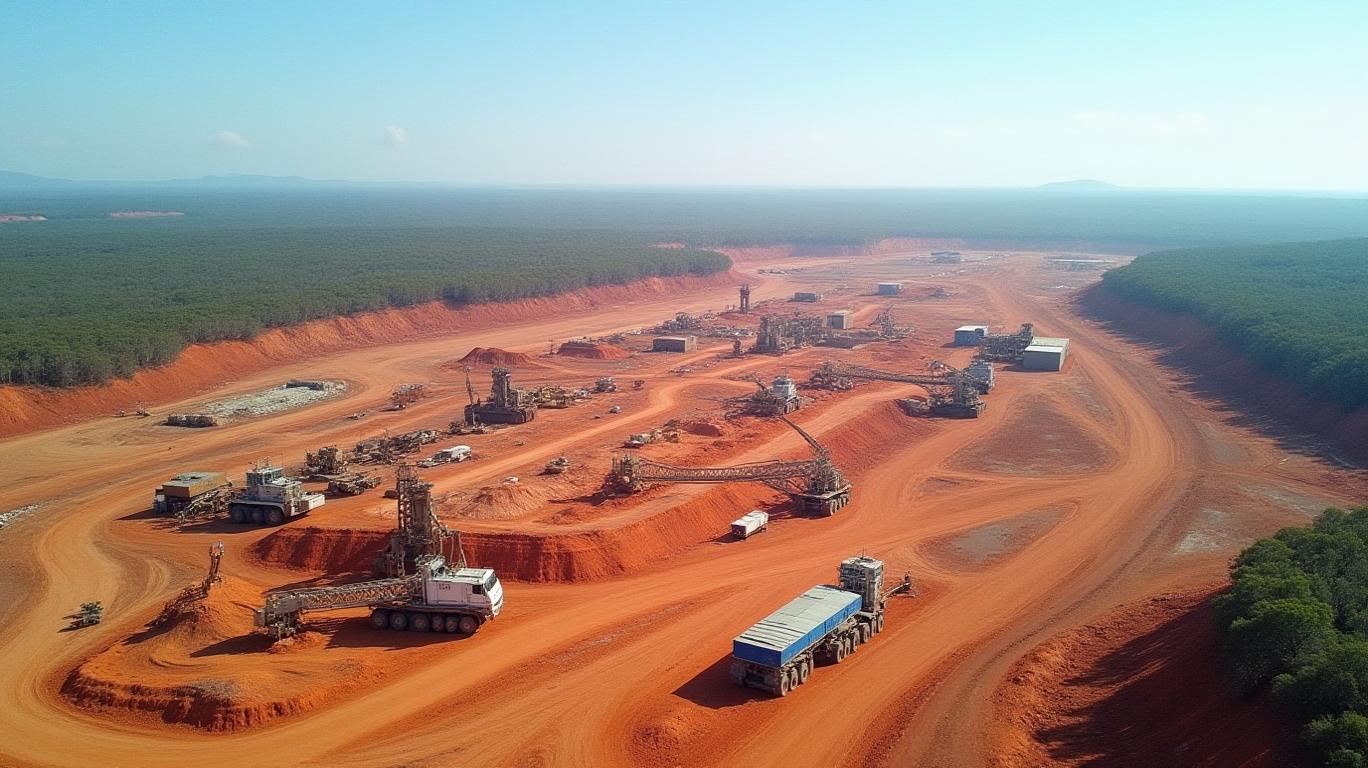
Rio Tinto’s decision to invest $1.9 billion in the Kangwinan bauxite project in Queensland, Australia, carries implications well beyond the Australian mining sector. For Guinea, one of the world’s leading bauxite producers and a major supplier to the global aluminium industry, the investment provides an important indication of how international mining companies are positioning themselves for the next phase of the global bauxite market.
Kangwinan is expected to add 20 million tonnes per year of bauxite capacity, increasing Rio Tinto’s Weipa operations to approximately 44 million tonnes annually. First production is targeted for 2029, with full production expected by 2032. The project will replace ageing production while strengthening Rio Tinto’s long-term supply platform.
For Guinea, the development highlights an increasingly important issue: competition among major bauxite-producing jurisdictions is likely to remain intense even as demand for aluminium grows.
Guinea’s Resource Advantage Is Not Enough
Guinea possesses one of the world's largest concentrations of high-quality bauxite resources and has significantly increased production and exports over the past decade. The country has attracted major international operators and expanded its role as a key supplier to Asian aluminium producers.
However, Kangwinan demonstrates that resource size alone will not determine future competitiveness.
Rio Tinto is investing in Kangwinan largely because it can leverage an established mining and logistics system. Ore will be transported by conveyor to existing stockyards and an expanded Amrun export facility, while the port upgrade will accommodate larger vessels and improve freight economics.
This is a particularly relevant lesson for Guinea.
The competitiveness of Guinean bauxite increasingly depends on the efficiency and reliability of the complete supply chain—from mine to rail, from rail to port, and from port to international customer. As production continues to expand, bottlenecks in rail capacity, port infrastructure, vessel turnaround and logistics coordination could become increasingly important determinants of delivered costs.
For Guinea's mining operators, this means that infrastructure investment should remain a strategic priority rather than simply an enabling component of individual mining projects.
A Warning Against Competing Only on Volume
Guinea has an opportunity to increase production substantially, but the Australian investment also raises a strategic question about whether continued volume growth should remain the industry's primary objective.
An additional 20 Mt/y from one major Australian operation represents a significant increase in global supply capacity. Other producers—including Guinea's rapidly expanding operations—are also pursuing production growth.
If multiple major producers increase output simultaneously, international buyers will have greater flexibility in sourcing bauxite. This could increase pressure on producers to demonstrate competitive delivered costs, consistent quality and supply reliability.
Guinean producers therefore need to focus not only on how many tonnes they can produce, but on the economics of delivering those tonnes to customers.
The Bigger Opportunity: Moving Beyond Raw Bauxite
Perhaps the most important lesson for Guinea concerns downstream integration.
Rio Tinto's investment forms part of an integrated aluminium value chain connecting Australian bauxite mines with alumina refineries and international customers. Guinea, despite its enormous bauxite resources, still exports most of its production as raw bauxite.
The growing investment by major mining companies in long-life bauxite assets strengthens the case for Guinea to accelerate its own transition from being primarily a raw-material supplier toward becoming a more integrated aluminium industry hub.
The country's growing alumina-refining ambitions are therefore strategically important. Developing additional refining capacity could allow Guinea to capture more value from each tonne of bauxite, create skilled employment and strengthen the country's position in the global aluminium supply chain.
Infrastructure and Industrial Policy Will Be Critical
Kangwinan also illustrates the importance of brownfield development. Rio Tinto is able to deploy significant capital while leveraging infrastructure that already exists at Weipa.
Guinea can apply a similar principle through coordinated development of mining corridors, railways, ports, power infrastructure and industrial zones. Shared infrastructure could lower the barriers to new mining projects while improving the competitiveness of existing operations.
At the same time, Guinea will need to strengthen environmental and social performance. Rio Tinto's emphasis on Traditional Owner engagement, cultural heritage and environmental management reflects the increasingly high expectations surrounding major mining projects globally.
For Guinea, stronger community engagement, local procurement, workforce development and environmental management will increasingly form part of the country's competitive proposition.
What Guinea Should Watch
The Kangwinan investment should therefore be seen as a strategic benchmark rather than simply a competing Australian project. It reinforces five priorities for Guinea's bauxite industry:
- Improve mine-to-port logistics and reduce delivered costs.
- Develop reliable, scalable shared infrastructure.
- Maintain consistent bauxite quality and supply reliability.
- Accelerate alumina refining and downstream aluminium opportunities.
- Strengthen environmental, community and local-content performance.
With its exceptional resource base, Guinea remains exceptionally well positioned in the global bauxite market. The challenge is to ensure that this geological advantage translates into a long-term industrial advantage.
Rio Tinto's $1.9 billion commitment to Kangwinan shows that leading mining companies are prepared to invest billions in securing competitive, long-life bauxite supply. For Guinea, the opportunity is not merely to produce more bauxite—but to build the infrastructure, industrial capacity and value chains that will make Guinean bauxite increasingly difficult to compete with globally.
Share on social media

-