


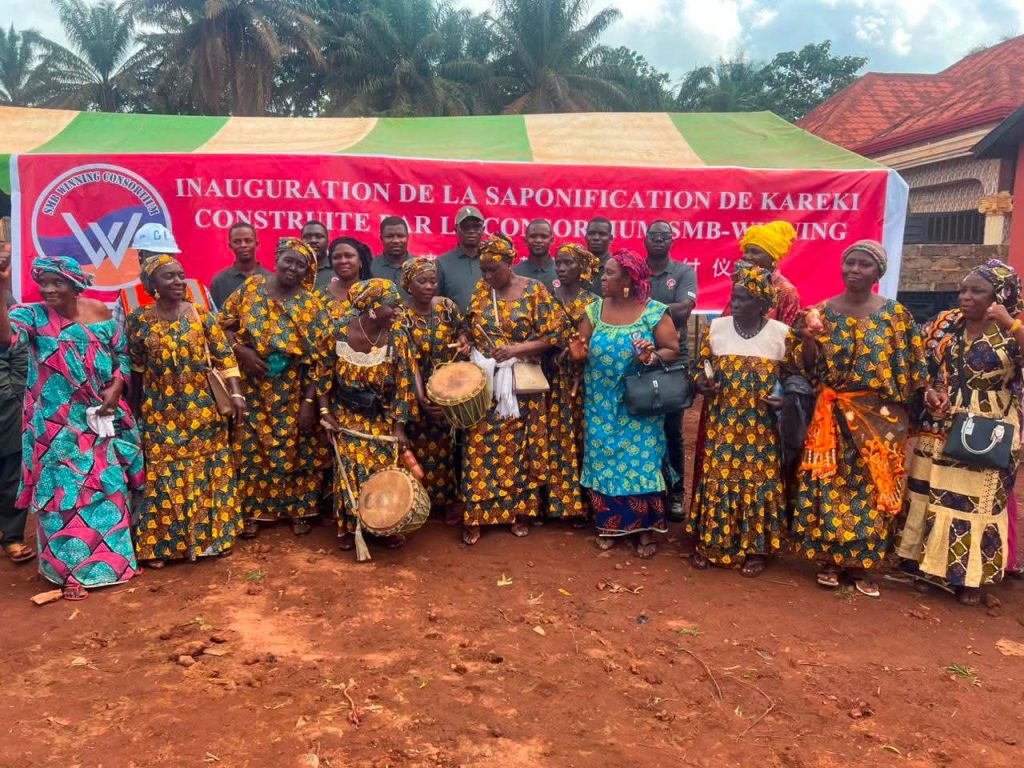
Kolaboui, Boké Region — The SMB-Winning Consortium, one of Guinea's leading bauxite mining and export operators, officially inaugurated a soap-making (saponification) center on July 22, 2026, in the village of Karéki Doubadiabiya, located in the Kolaboui sub-prefecture of the Boké prefecture. The facility, dedicated to the local Union of Women Farmers, marks the latest installment in the Consortium's ongoing corporate social responsibility (CSR) program within its bauxite mining catchment area.
Project Details
The 94.4-square-meter facility comprises a production hall, an administrative office, a storage warehouse, and a two-cabin latrine block. Construction was carried out by Groupe Emergence Services (GES) under a three-month contract, according to company manager Abdourahamane Kalabane. The center is intended to give local women a functional, secure workspace for manufacturing and selling soap products derived from local raw materials.
Community and Company Statements
N'Famara Kourouma, Director of Community Relations at SMB-Winning, described the center as evidence of the Consortium's commitment to sustainable development through income-generating activities (AGR) for women. He characterized the infrastructure as a symbol of peace, unity, and cooperation that opens new development opportunities for women, youth, and the wider community.
Kolaboui's deputy sub-prefect, Alhassane Camara, welcomed the facility as a genuine lever for economic empowerment, valorization of local know-how, and improved living conditions for mothers who anchor community entrepreneurship and youth employment. He added that local soap production should also strengthen public hygiene and health outcomes in surrounding villages.
Industry Analysis
This inauguration fits a well-established pattern among bauxite operators in Boké, where community relations spending has become a strategic necessity rather than a discretionary add-on. Boké hosts the highest concentration of active bauxite mining in Guinea, and land access, resettlement, and local employment expectations remain persistent friction points between operators and host communities. Small-scale, visible CSR investments — soap units, market infrastructure, boreholes, literacy centers — serve multiple functions for consortia like SMB-Winning: they satisfy obligations tied to mining conventions and environmental and social impact assessments, they build a local "social license to operate" that reduces the risk of community blockades or work stoppages, and they offer tangible, photographable proof points for both government oversight bodies and international offtake partners increasingly attentive to ESG performance.
For mining sector actors, several signals are worth tracking. First, the continued involvement of local subcontractors such as GES in delivering these facilities indicates an expanding domestic supply chain around mining CSR works, a segment that could offer contracting opportunities beyond the majors. Second, the framing around women's economic autonomy reflects growing alignment between Guinean mining CSR programs and international financing conditions — many project lenders and offtakers now expect gender-inclusive community development metrics. Third, and more cautiously, the scale of such interventions — a single soap unit for one village — remains modest relative to the scale of bauxite extraction in Boké, and stakeholders will want to see whether SMB-Winning's broader CSR portfolio scales commensurately with production growth and export volumes from the region.
As Guinea's bauxite sector continues to expand output and attract new investment, the balance between extraction-driven revenue and localized community benefit will remain a key metric for assessing the sector's long-term social sustainability.
Share on social media

-