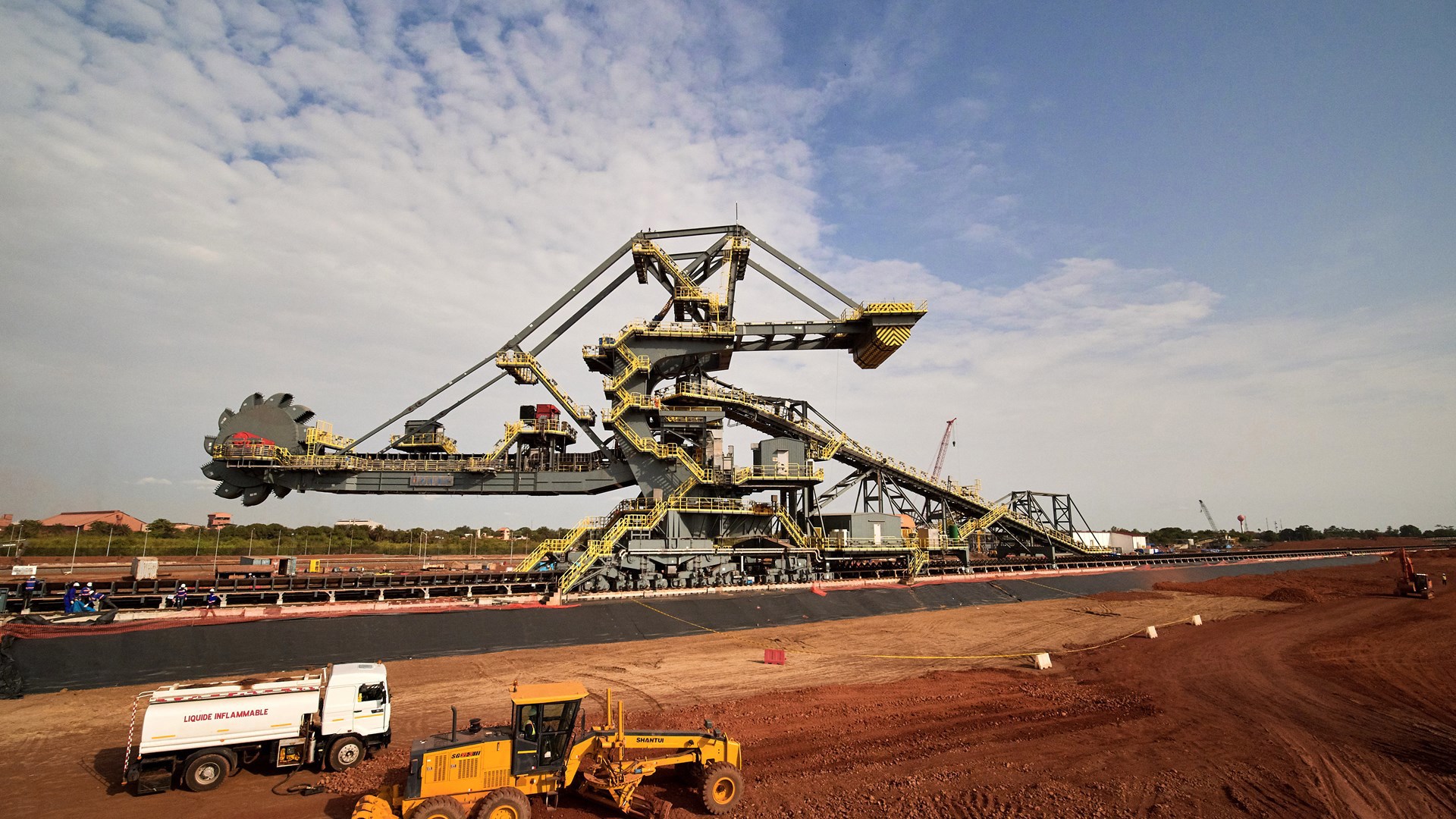
For investors evaluating opportunities in Guinea's bauxite sector, the Guinea Alumina Corporation (GAC) project presents a complex and evolving situation. Once heralded as the largest greenfield mining investment in Guinea in four decades, the project has experienced significant operational challenges that fundamentally alter the investment landscape from its promising 2018-2019 beginnings.
Project Background and Operational Achievement
The GAC project, developed by UAE-based Emirates Global Aluminium (EGA) through its Guinea Alumina Corporation subsidiary, successfully commenced operations in 2019 after its $1.4 billion first-phase investment. The project began exporting bauxite ore in 2019, achieving its target of producing up to 12 million tonnes of bauxite annually from its 690-square-kilometer concession in the Boké region.
The integrated project successfully delivered on its infrastructure promises, including mine development, port terminal construction at Kamsar, and railway upgrades connecting the Boké region to the coast. As of 2023, GAC employed some 3,200 people as employees and contractors, and spent approximately $283 million in local procurement, government payments and social contributions.
Critical Recent Developments: Export Suspension and License Revocation
The investment narrative shifted dramatically in October 2024. Guinean customs authorities suspended bauxite exports from GAC due to unresolved issues with the Guinean government, chiefly around concerns over GAC's failure to progress on its commitment to build domestic refining capacity. This suspension resulted in a 2 million tonne stockpile accumulating at Kamsar port.
The situation deteriorated further in 2025. In May 2025, the Republic of Guinea initiated proceedings to revoke EGA's mining license for GAC, following the October 2024 export suspension over customs duties concerns. By August 2025, EGA officially ceased all operations in Guinea, with GAC finalizing employee dismissals and terminating contracts with service providers, ending all presence and control over operations as of August 23, 2025.
The Alumina Refinery Initiative: Too Little, Too Late
Prior to the export suspension, GAC had made efforts to address government demands for local value addition. In June 2024, GAC signed a term sheet with the Government of Guinea for development of an alumina refinery with initial production capacity of one million tonnes per year, planned for the company's concession near Tinguilinta in Boké province.
The agreement included significant government participation: the Government would receive a 15 percent shareholding in GAC, converting to 10 percent of mining operations and 7.5 percent of the alumina refinery company when production began, plus two board positions including the Chair. However, these commitments proved insufficient to prevent the subsequent license revocation.
Broader Policy Context: Guinea's Resource Nationalism
The GAC situation reflects Guinea's broader push toward domestic value addition. Since 2022, the military government led by Mamadi Doumbouya has been pressuring mining companies to process bauxite locally. While Guinea exports over 100 million tons of bauxite yearly, the country has only one alumina refinery, creating significant pressure on miners to invest in local processing capacity.
Investment Implications and Risk Assessment
The GAC case study reveals critical investment risks in Guinea's mining sector:
Regulatory and Political Risk: The abrupt license revocation demonstrates that operational success and infrastructure investment provide limited protection against changing government priorities. Despite GAC's substantial economic contributions and employment generation, authorities prioritized local beneficiation objectives over existing operations.
Stranded Assets: The $1.4 billion first-phase investment, including specialized mining equipment, rail infrastructure, port facilities, and supporting infrastructure, represents potentially stranded capital following the forced exit.
Export Control Risk: The October 2024 export suspension showed how quickly government actions can halt cash flows, with the 2-million-tonne stockpile demonstrating the vulnerability of export-dependent operations.
Partnership Instability: Despite the June 2024 term sheet agreement offering government equity participation and board representation, the relationship deteriorated within months, suggesting that negotiated partnerships may provide limited operational security.
Market Impact and Supply Chain Disruption
EGA previously supplied bauxite to third-party customers globally, with some material shipped to its Al Taweelah alumina refinery in Abu Dhabi. The suspension and subsequent exit created supply chain disruptions, with aluminum prices surging following the October 2024 announcement.
Current Investment Perspective
For investors considering Guinea's bauxite sector, the GAC experience provides sobering lessons. While Guinea possesses exceptional bauxite resources—over a quarter of global reserves with high-quality ore—the investment environment has become significantly more challenging.
Key Considerations:
- Mandatory Local Processing: Future investments must incorporate alumina refining capacity from project inception, not as deferred second-phase commitments
- Government Partnership: Expect substantial government equity participation and operational oversight as prerequisites for new licenses
- Capital at Risk: Large infrastructure investments face seizure risk if operations conflict with evolving government priorities
- Timeline Uncertainty: Even projects with signed agreements face unpredictable regulatory changes
- Exit Barriers: The GAC case demonstrates limited options for protecting or recovering invested capital in disputes
Alternative Investment Approaches
Investors interested in Guinea's bauxite sector might consider:
- Joint ventures with state participation from project inception
- Integrated mining-and-refining projects demonstrating clear local value addition
- Partnerships with Chinese companies, who currently dominate Guinea's bauxite sector
- Smaller-scale operations with lower capital exposure
- Service provider roles rather than asset ownership
Conclusion
The GAC project evolved from being Guinea's largest greenfield mining investment success story into a cautionary tale about resource nationalism and regulatory risk. While the project successfully delivered on its technical promises—producing 12 million tonnes annually with comprehensive infrastructure—it ultimately failed to satisfy evolving government expectations for local value creation.
For investors, the GAC experience underscores that technical and operational excellence, substantial capital investment, and significant local economic contributions may prove insufficient to ensure operational continuity in environments where resource nationalism intensifies. Any future investment in Guinea's bauxite sector requires fundamental reassessment of risk premiums, project structures, and the realistic probability of achieving acceptable returns given demonstrated political and regulatory volatility.