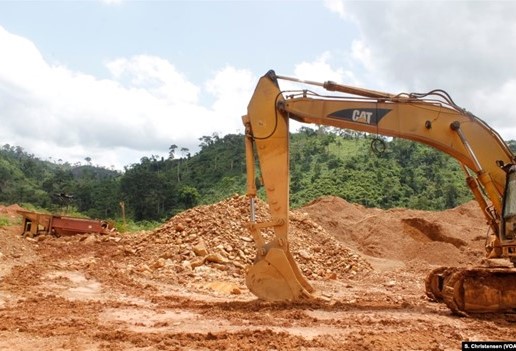
The Government of Guinea has introduced a nationwide ban on the use of heavy machinery at artisanal gold mining sites, marking a significant step in its ongoing efforts to regulate the country’s rapidly expanding artisanal mining sector. The decision, announced on March 13, 2026, through a joint communiqué by the ministries responsible for territorial administration, mining, and the environment, targets the growing mechanization of small-scale gold operations.
The measure was signed by Ibrahima Khalil Condé, Minister of Territorial Administration, Bouna Sylla, Minister of Mines and Geology, and Djami Diallo, Minister of Environment and Sustainable Development. It prohibits the use of excavators such as Poclain-type machines, bulldozers, backhoes, and any similar mechanical equipment on artisanal gold mining sites across the country.
Authorities say the move is aimed at addressing the environmental degradation, safety risks, and illegal large-scale mining practices that have increasingly emerged under the guise of artisanal operations. Over the past decade, the introduction of heavy machinery into what was traditionally manual gold panning has significantly altered the scale and impact of artisanal mining activities.
According to the government, mechanized operations in artisanal zones have accelerated soil degradation, damaged headwaters of major river systems, and contributed to severe pollution of waterways. In several gold-producing regions—particularly in the savannah zones of eastern Guinea—excavation with bulldozers and hydraulic machinery has led to widespread landscape disruption and the destruction of local ecosystems.
Beyond environmental concerns, authorities also highlight the growing safety hazards associated with mechanized artisanal mining. The use of heavy equipment in poorly structured and often unstable artisanal pits has been linked to an increase in fatal accidents, including collapses and landslides. These incidents pose risks not only to miners but also to nearby communities.
The ban forms part of a broader government strategy to formalize the artisanal and small-scale mining (ASM) sector in Guinea, which remains a critical source of livelihoods for thousands of rural workers but is frequently characterized by weak regulatory oversight. By restricting the use of heavy machinery, the government aims to distinguish genuine artisanal mining from illegal semi-industrial operations that exploit regulatory loopholes.
Officials also see the measure as a tool to combat the expansion of illicit gold extraction networks. In recent years, some operators have deployed excavators and bulldozers on sites officially designated for artisanal mining, effectively conducting industrial-scale operations without the required permits or environmental safeguards.
The new regulation introduces strict enforcement measures. Any heavy machinery found operating on artisanal mining sites will be immediately seized by authorities, and violators may face legal prosecution, financial penalties, or both. Local administrative officials—including governors, prefects, and sub-prefects—along with defense and security forces, have been tasked with ensuring compliance.
Industry observers note that enforcement will be the key challenge. Artisanal gold mining in Guinea is widespread, particularly in remote regions where monitoring capacity is limited. In parts of Upper Guinea, mechanized equipment has become increasingly common as operators seek to boost productivity and recover deeper deposits.
Nevertheless, the government is calling for collaboration from all mining stakeholders. Professional organizations, cooperatives, community groups, and mining companies have been urged to support the implementation of the measure and contribute to improving environmental and safety practices within the ASM sector.
For mining stakeholders in Guinea, the decision signals a renewed commitment by authorities to tighten governance in the gold sector while addressing the environmental and social impacts associated with unregulated artisanal mining. How effectively the ban is enforced in remote mining zones will ultimately determine its impact on the country’s ASM landscape.