


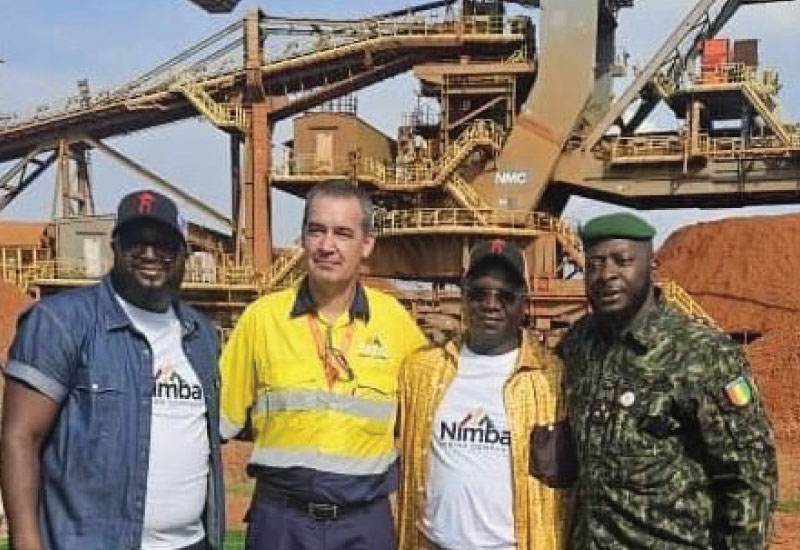
Guinea has taken a decisive step in its drive for mineral sovereignty with the formal signing of the mining convention for Nimba Mining Company (NMC), a wholly state-owned enterprise financed entirely through national capital. The ceremony, held at the Petit Palais of the Presidency and chaired by Djiba Diakité, Minister-Director of the Presidential Cabinet and Chair of the Simandou Strategic Committee, was framed by government officials as a historic milestone in Guinea's post-independence resource strategy.
A Legal Framework a Year in the Making
The convention arrives roughly one year after presidential decrees established NMC and granted it an exploitation permit. It formalises the reciprocal rights and obligations between the Guinean State and the company across the full value chain — from bauxite extraction at the Tinguilinta mine through to export via the Port of Kamsar — while fixing the fiscal, customs, environmental and social regime applicable to NMC's operations for the duration of its activities.
For mining actors evaluating exposure to Guinea, this legal certainty is the headline takeaway. Minister of Mines Bouna Sylla positioned the agreement as a continuation of the broader transactional settlement reached on 4 May 2026, which resolved an earlier dispute through negotiation rather than confrontation — a signal that the government is prioritising negotiated stability over unilateral action, at least for its own state vehicle.
Operational Momentum
NMC's operational figures, presented by CEO Patrice L'Huillier, are notable for a company only one year old. The company has extracted five million tonnes of bauxite, employs roughly 2,000 people — 98% of them Guinean — and has restored a mine, railway and port to service within twelve months, pushing exports past four million tonnes. Guidance points to ten million tonnes of production in 2026, scaling to 12 million tonnes annually from 2027.
Diakité described the convention as the first mining agreement signed by a 100%-state-owned company since independence, underscoring the government's intent to position NMC — alongside the broader Simandou 2040 programme — as a template for direct state participation in resource extraction rather than reliance solely on concession-based foreign investment.
Downstream Ambitions
Perhaps the most consequential detail for industry observers is NMC's confirmed launch of feasibility studies for a 1.2-million-tonne-per-year alumina refinery. This marks Guinea's clearest institutional move yet toward in-country bauxite processing, a long-stated ambition that has historically lagged behind the country's raw export volumes. Should the refinery advance from feasibility to construction, it would represent a structural shift in Guinea's position within the global aluminium value chain, reducing dependence on raw ore exports and capturing greater domestic value-add — alongside stated ambitions to eventually move into aluminium production.
Reading the Signals
Several elements merit attention from investors, contractors and offtake partners:
- Governance and content commitments: The convention embeds local content, training, employment and community development obligations, alongside transparency provisions — likely a template for future state-vehicle agreements.
- Continuity of workforce: Officials emphasised zero layoffs during the transition, with all employees from the predecessor structure absorbed into NMC — relevant for contractors assessing labour stability.
- External financing ties: Strengthened cooperation with the UAE, including Abu Dhabi fund-backed infrastructure (the Cosa interchange) and a €30-million agricultural project, suggests Gulf capital is playing an expanding role alongside domestic financing of the mining sector itself.
Outlook
With the convention now in force, NMC's near-term test will be execution: sustaining the ramp-up toward 10–12 million tonnes annually while advancing alumina feasibility studies to a bankable stage. For a sector accustomed to concession-driven foreign operators, NMC's trajectory offers a live case study in whether a fully state-financed miner can scale production, meet export targets and eventually anchor downstream processing — outcomes that will shape how other resource-rich states weigh similar sovereignty-driven models.
Share on social media

-