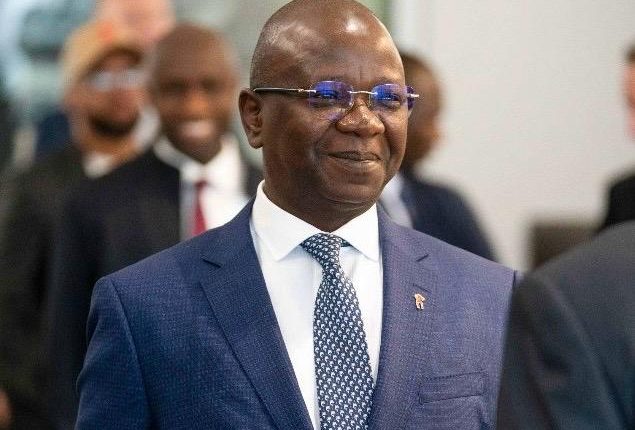
On the eve of the long-awaited launch of the Simandou iron ore production phase, Guinea’s Minister of Mines, Bouna Sylla, delivered a clear message to mining investors: the country is now a credible and reliable jurisdiction for large-scale capital deployment. Speaking Monday, Sylla emphasized that governance reforms under the Transitional Government have strengthened regulatory discipline, transparency, and investor protection, creating conditions for the most ambitious mining and infrastructure project in Africa.
According to the minister, international perception of Guinea has shifted significantly since 2021. “For investment and partnership building, trust is the key. And Guinea today is a country that deserves that trust,” Sylla said. He highlighted adherence to contractual commitments, respect for regulatory frameworks, and alignment with global standards for foreign direct investment as core pillars of current governance.
This renewed institutional credibility, he argued, is a major reason the Simandou project has been able to mobilize a uniquely global consortium. The transcontinental supply chain spans India, where locomotives are manufactured; the United States, which provides rolling stock; Asia and Europe, which supply financing and technology; and Australia, representing the Oceania mining expertise. “The world is converging on Simandou,” Sylla noted, describing the project as a rare global undertaking anchored on Guinean soil.
From a technical standpoint, Simandou’s high-grade iron ore continues to reinforce its strategic importance for steelmakers pursuing decarbonization. With ore grades above 65 percent Fe across several deposits, the mines are positioned to serve low-carbon steel pathways by reducing the energy intensity of blast furnace operations. For mining companies, this high-grade profile strengthens the long-term commercial case for integrated rail-port logistics despite the heavy upfront capital costs.
Sylla also linked governance reforms to the country’s new sovereign credit rating. In September, Standard & Poor’s issued Guinea a B+ rating with a stable outlook, the first sovereign rating in the country’s history. The minister framed this as a watershed moment that will expand access to private capital markets, lower financing premiums, and accelerate reforms essential for large mining and infrastructure developments. For industry actors, this rating suggests an improving risk environment, though still within the lower tier of speculative markets.
Looking ahead, Sylla described the inauguration of Simandou’s production phase not only as an industrial milestone but as a symbolic turning point in Guinea’s economic trajectory. While political independence dates back to 1958, he argued that economic sovereignty begins with the ability to leverage national mineral wealth through transparent governance and globally competitive operations.
For mining companies assessing expansion opportunities, the minister’s remarks highlight two key signals: greater regulatory predictability and a maturing macro-financial environment. Combined with the scale and grade of Simandou, these dynamics position Guinea as one of the continent’s most consequential mining frontiers in the coming decade.