


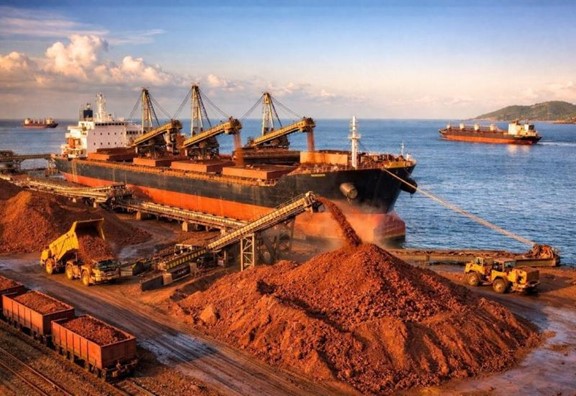
Guinea’s mining sector continued to demonstrate strong export momentum in the second quarter of 2026, with bauxite and iron ore shipments reaching 59.93 million tonnes combined, according to statistics from the Bureau for the Evaluation of Quantities of Mining Products (BEQPM), under the Ministry of Mines and Geology.
The figures underline Guinea’s growing importance as a major supplier of bulk minerals to international markets, while also highlighting the increasing contribution of iron ore alongside the country’s established bauxite industry.
Bauxite remains the backbone of mineral exports
Bauxite exports reached 53.89 million tonnes during Q2 2026, equivalent to approximately 340 vessels. The scale of these shipments confirms the continued expansion and operational resilience of Guinea’s bauxite industry.
The Société Minière de Boké (SMB) remained the largest exporter, shipping 16.95 million tonnes, followed by CHALCO with 7.73 million tonnes and the Compagnie des Bauxites de Guinée (CBG) with 4.13 million tonnes.
Other significant contributors included NIMBA MINING COMPANY, with 2.24 million tonnes, COBAD with 1.97 million tonnes, and FRIGUIA with 131,406 tonnes.
The latest weekly data also illustrate the intensity of Guinea’s export logistics. Between 31 August and 6 September, the country shipped 4.22 million tonnes of bauxite on 27 vessels. SMB alone accounted for approximately 1.10 million tonnes during the week.
Shipments moved through a network of mining ports and export facilities including Kamsar, Dapilon, Katougouma, Kokaya, Cape Verga, Taressa, GSJ and Conakry.
For mining operators, this concentration of volumes across multiple export corridors is strategically important. It demonstrates the scale of infrastructure required to support Guinea’s mining growth and makes port capacity, haulage networks, stockyard management and vessel turnaround increasingly critical to maintaining export performance.
Iron ore gains strategic importance
While bauxite continues to dominate by volume, Guinea’s iron ore industry is emerging as an increasingly important second pillar of the mining economy.
Iron ore exports reached 6.04 million tonnes in Q2 2026, shipped on 28 vessels. BWCS accounted for the largest share with 3.66 million tonnes, followed by RIO TINTO-SIMFER with 1.60 million tonnes and XINYUAN MINING-SGMF with 780,081 tonnes.
The performance of the Simandou project is particularly significant. BEQPM quality certifications recorded during July and early September indicate iron grades generally above 65% Fe for Simandou-related shipments. Such grades reinforce the commercial attractiveness of Guinea’s iron ore at a time when steelmakers are increasingly focused on higher-quality feedstocks capable of supporting lower-emission steelmaking pathways.
What the numbers mean for mining investors
The Q2 figures point to three broader trends.
First, Guinea is moving toward greater export diversification. Bauxite remains the dominant commodity, but the emergence of large-scale iron ore exports creates an additional source of mining revenue and strengthens Guinea’s position in global mineral supply chains.
Second, logistics will increasingly determine the pace of growth. Export volumes approaching 60 million tonnes in only one quarter place substantial demands on ports, railways, roads, transshipment systems and supporting services. The ability to expand infrastructure in parallel with production will be critical to avoiding bottlenecks.
Third, Simandou could materially reshape Guinea’s mining profile. The combination of substantial volumes and high-grade ore gives the iron project strategic importance well beyond its direct production contribution. Its development is likely to generate new opportunities for mining services, infrastructure, logistics, engineering, equipment supply and downstream industrial activity.
Overall, Guinea’s Q2 2026 export performance confirms that the country is not merely maintaining its position as a major bauxite producer; it is progressively building a two-pillar mining economy anchored by bauxite and high-grade iron ore. The next challenge will be ensuring that infrastructure, regulatory capacity and local mining ecosystems can keep pace with this accelerating export growth.
Share on social media

-