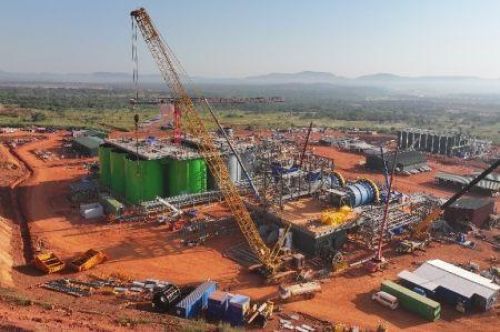
Guinea's mining sector receives a significant boost as Robex Resources nears completion of the $243 million Kiniero gold mine redevelopment, though pending corporate consolidation adds complexity to the asset's trajectory.
Robex Resources has reached a critical milestone in the recommissioning of Guinea's Kiniero gold mine, with processing plant commissioning now underway and initial ore stockpiles positioned for treatment. The Canadian miner confirmed on November 17 that construction remains on schedule and within budget, targeting first gold production before year-end. This achievement represents the successful revival of a dormant asset and establishes Robex's second producing operation alongside its Malian flagship.
Project Economics and Production Profile
The Kiniero redevelopment carries an initial capital requirement of $243 million, with $50 million expended as of October 2023, indicating substantial investment progress prior to the current commissioning phase. The operation is designed as a conventional open-pit mine feeding a 4.1 million tonnes per annum gravity-CIL processing facility—a proven flowsheet appropriate for Guinea's geological context.
The mine plan targets 851,000 ounces of recovered gold over a 9.5-year life of mine, translating to average annual production of 90,000 ounces. However, production is front-loaded, with the first three years averaging 105,000 ounces annually and 2026 specifically targeting 155,000 ounces—a profile suggesting early access to higher-grade oxide material. The metallurgical performance appears robust, with recovery rates of 92% for oxide and laterite ores, dropping marginally to 86% for fresh material.
At a projected all-in sustaining cost of $980 per ounce, Kiniero positions itself competitively within the current gold price environment. The 2.8:1 waste-to-ore strip ratio is reasonable for West African open-pit operations, though the relatively modest processed grade of 1.09 g/t necessitates operational discipline to maintain cost control.
Resource Expansion and Optimization Pathway
Robex's systematic approach to resource delineation demonstrates sound mine development practice. The December 2023 mineral resource update delivered a 52% increase in inferred resources through drilling at the Mansounia deposit, adding 896,000 ounces—a substantial addition that effectively doubles the current reserve base of 968,000 ounces.
The company is now advancing an optimized feasibility study to incorporate Mansounia resources, accommodate increased oxide throughput of 4.1 million tonnes annually, and design flexibility for potential expansion to 6 million tonnes per annum. This expansion optionality is particularly valuable, as it provides the merged entity—should the Predictive Discovery transaction complete—with a clear pathway to extend mine life and leverage existing infrastructure investments.
The total indicated resource base of 1.481 million ounces (including reserves) and inferred resources of 1.090 million ounces suggest significant upside potential beyond the current nine-year plan, particularly if Mansounia converts to reserves and additional brownfields exploration proves successful.
Strategic Context and Merger Implications
Kiniero's commissioning coincides with Robex's planned merger with Predictive Discovery, expected to close by December 2025 or early 2026, with Robex being incorporated into the Australian company. Predictive brings the high-quality Bankan project—capable of producing 250,000 ounces annually over 12-plus years—creating a combined Guinean platform of substantial scale.
This consolidation reflects broader industry trends toward portfolio optimization and jurisdiction-focused strategies in West Africa. However, the impact on Kiniero's development trajectory remains uncertain, as the merged entity will need to allocate capital and management resources across multiple assets. Kiniero's lower production profile relative to Bankan may influence prioritization decisions, though its near-term cash generation could prove valuable for funding Bankan's advancement.
Outlook and Risk Considerations
Robex's assertion of being "fully funded" for Kiniero's completion removes near-term financing risk, a significant positive given the capital-intensive nature of mine commissioning. The company's existing Nampala mine in Mali produced 34,401 ounces through September 2025, demonstrating operational competence, though Mali's elevated geopolitical risk profile makes geographic diversification into Guinea strategically prudent.
The Kiniero restart capitalizes on legacy infrastructure from the mine's 2002-2014 operational history, which delivered 418,000 ounces, reducing greenfield development risk. Nevertheless, ramp-up execution, metallurgical performance validation at scale, and integration into a merged corporate structure represent key near-term watchpoints for stakeholders monitoring Guinea's gold sector development.