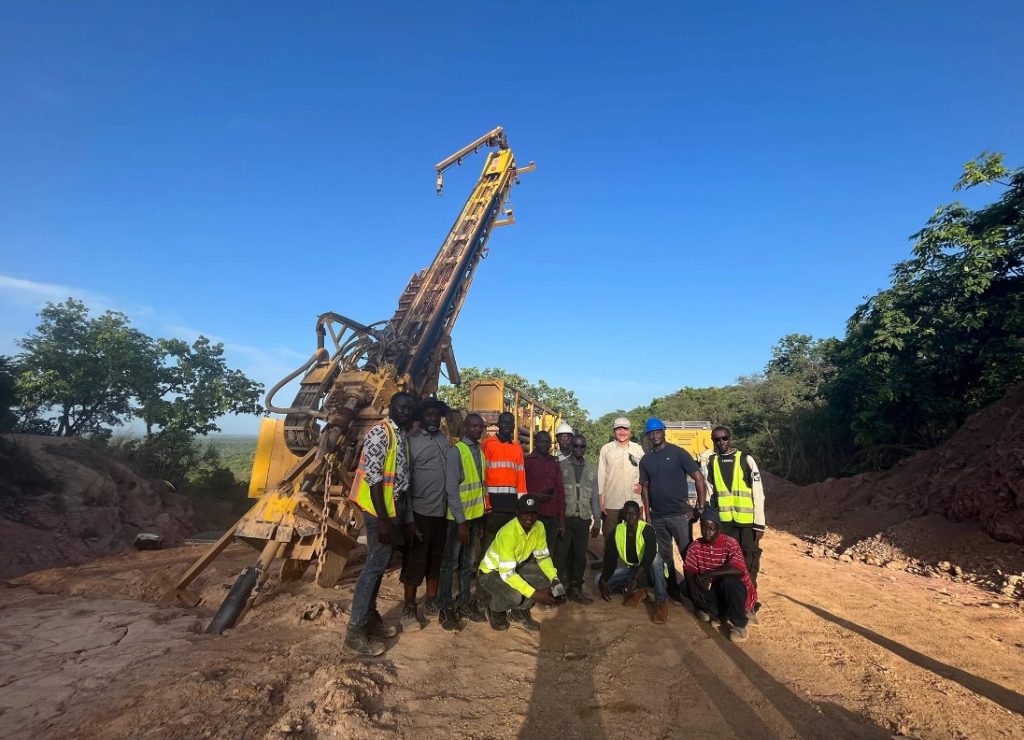
Sanu Gold Corporation has reported encouraging results from its 17,802-metre fiscal year 2025 drilling campaign across three exploration permits in Guinea's prolific Siguiri Basin, with the flagship Daina property emerging as a substantial, district-scale gold system warranting accelerated development.
Daina Property: A Maturing Exploration Story
The Daina property consumed the lion's share of exploration capital in FY-2025, with 12,896 metres drilled across 164 holes utilizing air core, reverse circulation, and diamond drilling methodologies. The campaign has successfully delineated a broad mineralized corridor extending over four kilometres along a north-northwest structural trend, with mineralization remaining open both along strike and at depth—a critical factor for resource expansion potential.
The Daina 2 Target represents the most mature prospect within the property portfolio. Step-out air core drilling has traced mineralization to a vertical depth of approximately 245 metres, with intercepts of significant grade and thickness. Notable intersections include 16 metres at 1.81 g/t gold from 44 metres depth, featuring a high-grade core of 2 metres at 12.24 g/t, and 12 metres at 1.71 g/t from shallow depth (12 metres), demonstrating the presence of both near-surface oxide potential and deeper primary mineralization.
Structurally, the deposit exhibits characteristics consistent with orogenic gold systems prevalent throughout the Siguiri Basin. Diamond drilling has revealed a north-northwest-striking reverse brittle-ductile shear zone dipping moderately southwest, hosted within deformed greywacke sequences with quartz-carbonate veinlets and disseminated sulphides—a mineralization style directly analogous to producing deposits in the district, notably those operated by AngloGold Ashanti and others in the region.
Geological Continuity Emerging
The Salat East Target introduces a different geological setting with gold mineralization hosted in hydrothermally altered granodiorite, intersected over 500 metres of strike. The presence of intrusion-hosted mineralization adds geological diversity to the portfolio and suggests potential for different mineralizing events. Intercepts of 21 metres at 1.02 g/t from 17 metres depth, including higher-grade zones, and deeper mineralization extending to 281 metres (1 metre at 15.41 g/t) indicate a robust vertical extent to the system.
At Daina 1 South, drilling has traced mineralization over 1.3 kilometres of strike to a vertical depth of 200 metres, with intercepts including 9 metres at 1.22 g/t from 175 metres depth. The presence of multiple parallel mineralized structures exposed in artisanal workings suggests a complex structural architecture that may host numerous mineralizing conduits—a favorable indicator for tonnage potential.
Strategic Implications
From an exploration perspective, Sanu Gold is executing a methodologically sound approach: utilizing cost-effective air core drilling for broad target definition, followed by RC drilling for initial grade assessment, and targeted diamond drilling for structural understanding and depth extensions. This tiered strategy maximizes capital efficiency while systematically de-risking targets.
The company's CAD 22 million cash position provides runway for continued aggressive exploration through FY-2026, with plans for infill drilling at Daina 2, induced polarization surveys to extend Salat East and close the nine-kilometre gap between Daina 1 South and North, and first-pass drilling of untested surface anomalies. This financial capacity is critical in a jurisdiction like Guinea, where sustained exploration momentum can provide competitive advantages in discovery and permitting timelines.
Bantabaye and Diguifara: Pipeline Value
While Daina commands immediate attention, the Bantabaye and Diguifara properties present pipeline value. At Bantabaye, 93 kilometres of IP geophysics combined with soil sampling and auger drilling have outlined multiple gold anomalies over eight kilometres of strike, with diamond drilling confirming mineralization to 300 metres depth (4 metres at 3.00 g/t from 169 metres). The identification of high-grade artisanal workings yielding rock-chip samples up to 48.2 g/t provides vector targets for systematic drill testing in Q1-2026.
Diguifara's wide mineralized intercepts across three targets—including 66 metres at 0.33 g/t and 58 metres at 0.38 g/t—demonstrate a large-footprint system that, while currently lower grade, may host higher-grade shoots amenable to selective mining or bulk-tonnage scenarios depending on metallurgical characteristics.
Market Positioning
Sanu Gold is positioning itself within the Siguiri Basin during a period of heightened interest in West African gold assets. The basin's geological endowment is proven, with AngloGold Ashanti and other operators demonstrating commercial viability. The company's systematic approach to building a multi-million-ounce discovery inventory, combined with an experienced management team with track records in resource development and mine permitting, positions the company favorably for either organic development or strategic partnership.
The Q1-2026 drill program will be pivotal. Infill drilling at Daina 2, extensional work at Salat East, and first-pass testing of southern Bantabaye targets should provide clarity on resource scale and grade distribution. For mining actors evaluating Guinea exposure, Sanu Gold presents an emerging story with defined drill targets, adequate funding, and geological models consistent with producing deposits in the district—key de-risking factors in frontier exploration.
The company's ability to convert its four-kilometre mineralized corridor at Daina into a maiden resource estimate will likely dictate its trajectory through 2026 and beyond.