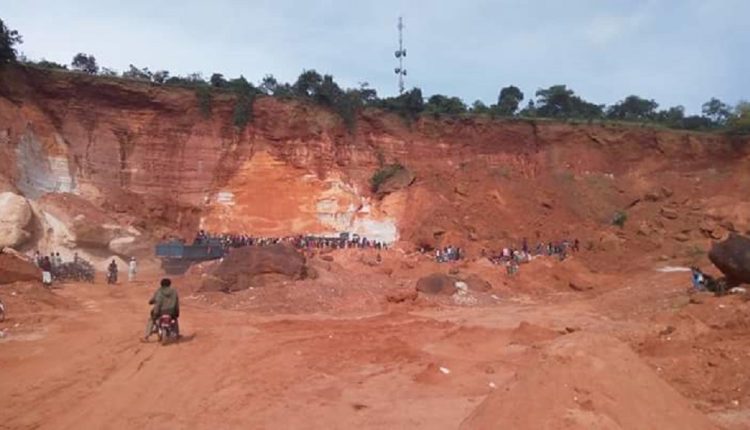
The prefecture of Siguiri, long considered the beating heart of Guinea’s gold economy, is once again at the centre of national attention. Recent clashes between security forces and local residents—triggered by the arrest of artisanal mining figure Ali Thiam and intensifying opposition to semi-industrial mining operations—highlight a deepening crisis that goes far beyond public disorder. They expose the structural dilemma facing communities who feel trapped between government restrictions on traditional gold mining, the growing influence of foreign semi-industrial actors, and the accelerating degradation of their agricultural lands.
What is unfolding in Siguiri is not merely a security challenge; it is an economic, environmental, and governance stress point that speaks to the future of mining in Haute-Guinée.
A Region Under Tension
On multiple occasions in recent weeks, Siguiri’s urban commune has been paralysed by violent confrontations. Demonstrations on 30 November 2025 brought thousands of youth into the streets, blocking major intersections, burning tyres, and hurling stones at security forces. Protestors demanded the withdrawal of Poclain excavators and the expulsion of Chinese operators engaged in semi-industrial gold mining on nearby lands.
The unrest followed the earlier arrest of Ali Thiam, a known artisanal mining organiser, seen by many youth as a protector of their right to access the region’s gold resources. His detention sparked an initial wave of clashes, leaving several injured and causing extensive property damage. Eyewitness accounts accuse security forces of heavy-handed intervention, including assaults on passengers at the Siguiri bus station.
Local officials have attempted to calm tempers, with the president of the délégation spéciale urging residents to await negotiations. But the situation remains volatile, fuelled by deep frustration and long-standing socioeconomic grievances.
A Population Caught Between Restriction and Exclusion
At the core of the tension is a contradiction that many residents find increasingly intolerable:
- Traditional artisanal gold mining (orpaillage)—a livelihood for tens of thousands in Haute-Guinée—has been heavily restricted or banned in several areas as part of government efforts to curb environmental degradation.
- Semi-industrial mining by foreign operators, particularly from China, Mali, and Burkina Faso, continues to expand with official authorization.
- Local communities, meanwhile, say they see few benefits and bear the environmental cost.
This dual system creates a perception of unequal treatment: local miners are policed and criminalised, while better-connected operators with heavier machinery continue activities that generate deeper, more lasting impacts on the land.
For many youth, traditional gold mining is not simply a job—it is the only source of income available in a region with limited agricultural viability and minimal formal employment. The ban has therefore removed their economic lifeline without providing alternative livelihoods, deepening resentment and fueling confrontation.
Environmental Decline: A Crisis Hidden Beneath the Surface
While the political and social dimensions have dominated headlines, the environmental decline in Siguiri and neighbouring prefectures may ultimately prove the most devastating consequence of unmanaged gold extraction.
A recent inspection report from the Ministry of Mines and Geology, as well as on-ground testimonies, paints a stark picture:
1. Loss of Agricultural Land
The proliferation of artisanal and semi-industrial mining pits has consumed thousands of hectares of formerly cultivable land.
- Traditional extraction methods involve digging pits up to 10–15 metres long and 1–3 metres deep.
- In semi-industrial zones, excavators create trenches up to 50 metres long and 20 metres wide.
These pits are rarely rehabilitated, leaving behind a fragmented, sterile landscape that undermines food production and contributes to rising food prices.
2. Waterway Pollution and Depletion
Rivers and streams—once central to irrigation, fishing, and domestic use—are now gravely threatened.
- Mercury and cyanide used for gold amalgamation contaminate the water table.
- Drague (dredging machines) stir up sediment, destroy aquatic habitats, and accelerate riverbank erosion.
- Pumping systems deplete groundwater, drying up streams and exposing communities to water scarcity.
In many villages, fish mortality, muddy riverbeds, and vanishing wetlands are now common observations.
3. Accelerated Deforestation and Biodiversity Loss
Mining zones require land clearing, timber extraction for pit reinforcement, and fuelwood for camp life.
Local forestry officers report that extensive patches of Haute-Guinée now resemble “lunar landscapes” due to unregulated mining.
The disappearance of vegetation has triggered:
- loss of wildlife, including bird and small mammal populations,
- increased soil erosion,
- diminished resilience of local ecosystems during extreme weather,
- heightened flood risk.
Economic Promise vs. Social Reality
Siguiri’s wealth has long been celebrated, but residents argue that they remain marginalised participants in their own gold economy.
According to community testimonies and local advocacy voices such as Seydou Koita, native populations benefit little from the region’s mining boom. They denounce:
- unequal access to mining permits,
- land dispossession without fair compensation,
- employment practices that favour foreign labour,
- perceived collusion between local authorities and external operators.
This perception of exclusion intensifies community resistance whenever new semi-industrial operations begin.
As one local resident put it:
“Our land feeds the nation’s economy, but our communities are trapped in poverty. When artisanal mining is banned, we are told to respect the law. But when foreigners destroy our fields with machines, we are told to stay quiet.”
Governance Challenges: Managing a Complex Landscape
The Guinean government faces a difficult balancing act in Haute-Guinée:
- Curb environmental destruction associated with unregulated artisanal mining.
- Formalize and attract responsible investment in the sector.
- Maintain public order in a region where artisanal mining is deeply embedded in socio-economic identity.
- Ensure communities perceive tangible benefits from semi-industrial projects.
The escalation of tensions in Siguiri indicates that current policies may not adequately address the community dimension. Without inclusive dialogue and community participation, enforcement actions risk triggering more unrest.
A Crucial Moment for Siguiri’s Mining Future
The crisis in Siguiri underscores an essential point: sustainable mining cannot exist where communities feel dispossessed, excluded, or forced into illegality to survive.
If the region is to move toward a stable mining economy, three urgent priorities emerge:
- Inclusive Local Dialogue:
Authorities must engage directly with youth, artisanal miners, landowners, and local civil society to renegotiate the social contract around mining. - Environmental Rehabilitation and Land Management:
A structured program for reclaiming mined-out land is essential to restore agricultural productivity and ecological balance. - Fairer Access to Gold Resources:
Mechanisms allowing local cooperatives to obtain legal artisanal permits, operate under controlled standards, and benefit economically are necessary to reduce tensions.
Without a coherent strategy, Siguiri risks remaining trapped in a cycle of resource extraction, social unrest, and environmental decline.
For now, the population waits—with hope, frustration, and rising determination—for solutions that respect both their land and their future.