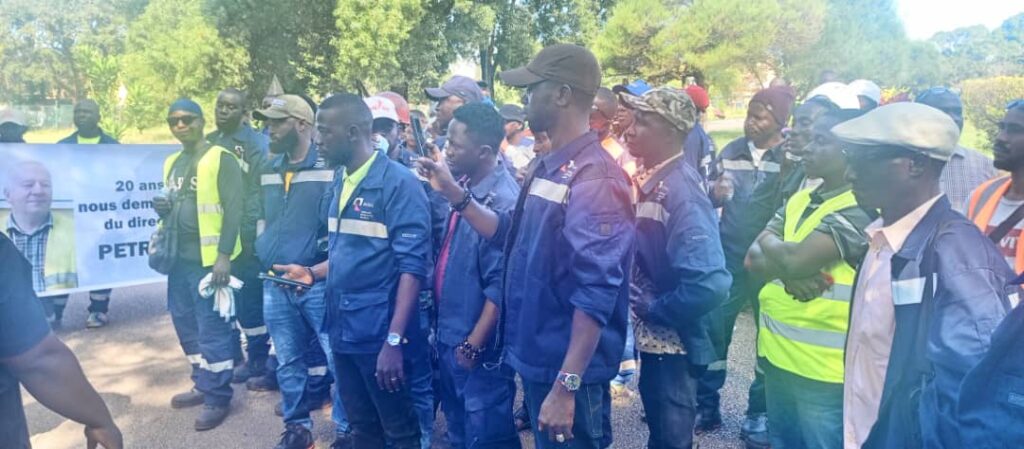
Operations at Compagnie des Bauxites de Kindia (CBK), a subsidiary of Russian aluminum giant RUSAL, have come to a standstill following the launch of an indefinite strike by the company’s workforce in Kindia, western Guinea. The strike, which began on October 14, underscores growing tensions between management and employees over the implementation of Guinea’s new mining collective agreement—and highlights deeper governance and labor-relations challenges in the country’s bauxite sector.
Hundreds of CBK workers gathered outside the company’s headquarters demanding compliance with the sector-wide collective agreement, which sets a new minimum base salary of GNF 8.5 million (approximately USD 986) for mining workers. Currently, many CBK employees reportedly earn between GNF 2.3 and 2.6 million, sparking frustration over what they see as the company’s deliberate resistance to the new wage structure.
The strikers are also calling for the dismissal of General Manager Peter Gaevskiy, accusing him of obstructing the implementation of the agreement and showing disregard for Guinean labor law. “As long as Gaevskiy remains in charge, we will not return to work,” one union representative told Guinea Mining Insights on condition of anonymity. The workers also demand the removal of Salifou Camara, the head of operations, whom they accuse of poor labor practices.
The strike has paralyzed CBK’s operations, with mining trains halted and extraction sites inactive. According to local reports, the company’s general management offices remained closed during the demonstrations, while the general manager was reportedly absent from the site.
In their strike notice, CBK’s labor representatives cite the company’s violation of Articles 131.2 and 131.4 of the Guinean Labor Code, as well as its non-compliance with the newly ratified mining convention and job classification grid. The union insists it remains open to dialogue—but only under the mediation of the Labor Inspectorate to ensure neutrality.
For RUSAL, which controls CBK under a 25-year concession agreement signed in 2001, the dispute poses both operational and reputational risks. CBK contributes roughly 25% of RUSAL’s total bauxite output, with much of its production—around 3.5 million tons annually—exported to the Nikolaev alumina refinery in Ukraine and other destinations. Any prolonged disruption could affect RUSAL’s global supply chain and further strain relations between the company and Guinean authorities.
This is not the first time CBK has faced labor unrest. Since its privatization, the company has been criticized for poor working conditions, low wages, and inadequate community engagement. Past strikes in 2009 and 2012 also centered on wage disputes and social grievances.
For mining operators in Guinea, the CBK standoff serves as a reminder of the increasing assertiveness of labor unions and the importance of aligning corporate practices with national labor reforms. With Guinea tightening oversight across its mining industry—particularly on social and governance issues—companies are expected to demonstrate compliance and transparent labor relations to maintain their social license to operate.
As the strike continues, the key question remains whether CBK and RUSAL will move swiftly toward negotiation—or risk prolonging a crisis that could reverberate across Guinea’s vital bauxite supply chain.