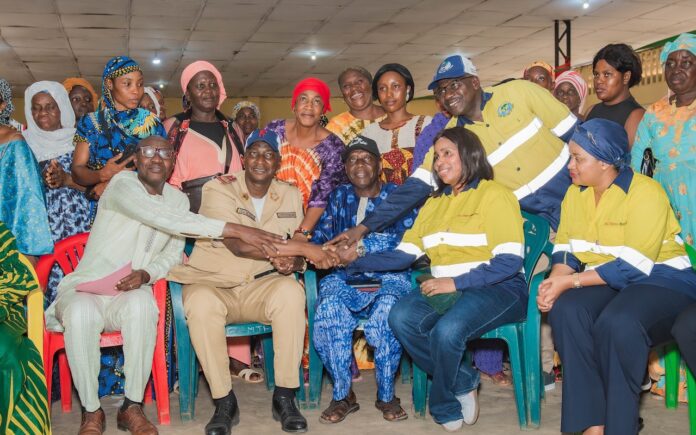
Forécariah, Guinea – Rio Tinto has concluded a 24-month “Second-Chance Education and Vocational Training Program for Women” in the prefecture of Forécariah, marking a significant milestone in the company’s community development strategy linked to the Simandou iron ore project. The closing ceremony, held at the Maison des Jeunes in Forécariah, brought together local authorities, representatives of the Ministry of Pre-University Education and Literacy, civil society partners, and beneficiaries.
Beyond its social impact, the program offers a compelling case study for mining operators in Guinea and across West Africa: structured, long-term investment in human capital can generate measurable economic outcomes and strengthen a project’s social license to operate.
Implemented in partnership with the NGO Club des Amis du Monde (CAM) and local authorities, the pilot initiative targeted 800 girls and women excluded from formal education systems. Using an integrated approach—functional literacy, vocational training, and economic structuring—the program aimed to facilitate socio-professional reintegration and create sustainable livelihoods.
The results are notable by any development or industry standard. Of the targeted participants, 789 successfully completed the program, representing a 92% completion rate across 32 operational literacy centers. Thirty-two Economic Interest Groups (Groupements d’Intérêt Économique – GIE) were created and formally registered in high-potential sectors including agriculture, tailoring, soap-making, baking, and fishing. Today, 93% of beneficiaries are engaged in income-generating activities, while 91 young girls have transitioned back into formal education or further vocational training.
For mining stakeholders, these metrics translate into more than social goodwill. They demonstrate the emergence of a structured local economic fabric capable of supporting ancillary services, supply chains, and community stability around large-scale mining operations. In regions like Forécariah—strategically located along key infrastructure corridors for Simandou—local capacity-building reduces dependency risks and mitigates socio-economic tensions often associated with major resource projects.
Safiatou Diallo, Director of Regional Economic Development at Rio Tinto Guinea, framed the initiative as a core pillar of the company’s development vision: “By giving access to knowledge and skills, we open the door to autonomy, entrepreneurship, and human dignity. This program illustrates the tangible impact of Simandou on local communities.”
Importantly, the program aligns with Guinea’s national education framework, the Programme Décennal de l’Éducation en Guinée (ProDEG 2020–2029). This alignment enhances institutional legitimacy and ensures that corporate-led interventions reinforce, rather than substitute, public policy objectives—a critical factor for long-term sustainability.
For the mining sector, the Forécariah experience underscores a strategic shift: community development is no longer peripheral to project economics. In a context where ESG performance increasingly influences financing, permitting, and investor confidence, programs that deliver quantifiable socio-economic outcomes become operational assets.
As Guinea positions itself as a world-class mining jurisdiction, the success of this initiative sets a replicable model. It shows how mining projects can catalyze inclusive growth, particularly for women—an often underutilized economic force in rural areas. For operators engaged in bauxite, gold, or iron ore, the message is clear: investing in people is not philanthropy alone; it is risk management, value creation, and a foundation for durable partnerships with host communities.