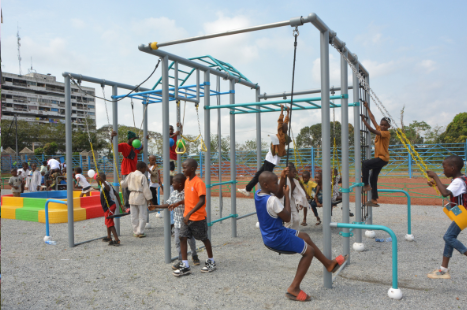
Fria, Guinea – RUSAL's Friguia alumina refinery has completed a comprehensive community development project, converting a 1.3 billion Guinean franc ($150,000 USD) investment into a modern sports and leisure facility at the heart of Fria's mining town. The project, inaugurated on November 30, 2025, represents a significant escalation in corporate social responsibility efforts by the Russian aluminum major in Guinea's bauxite-rich Boké region.
Project Genesis and Execution
The initiative originated from a December 2023 commitment by RUSAL Friguia to eliminate an unauthorized waste dump that had become both an environmental hazard and public health concern in Fria's city center. Following nearly twelve months of administrative procedures, remediation and construction works commenced in October 2024, executed entirely by Friguia plant personnel utilizing local resources and expertise.
General Director Aleksey Sakhachev, who has led the operation for two years, positioned the project as integral to his operational philosophy that mining facilities and their host communities must advance in tandem. The transformation of contaminated land adjacent to the prefecture offices into functional recreational infrastructure demonstrates a practical application of this integrated approach to mine-community relations.
Strategic Context for Mining Operators
This development merits attention from mining sector stakeholders for several reasons. First, it exemplifies how legacy industrial operations can leverage remediation obligations to generate positive community outcomes rather than viewing environmental cleanup as purely regulatory compliance. The co-location strategy—addressing an environmental liability while simultaneously meeting community infrastructure needs—offers a template for cost-effective social license maintenance.
Second, RUSAL's approach reflects evolving expectations around mining companies' role in municipal infrastructure, particularly in single-industry towns where the line between corporate and civic responsibility blurs. Sakhachev's announcement of additional 2026 initiatives, including urban road rehabilitation, signals a comprehensive infrastructure engagement strategy extending beyond traditional CSR boundaries into quasi-municipal functions.
Implications for Guinea's Mining Sector
The timing and scope of this investment warrant analysis within Guinea's broader mining landscape. As the country seeks to attract investment for downstream processing and value addition in its bauxite sector, RUSAL's visible community engagement provides operational proof-of-concept for sustainable mining models. The project's execution entirely through internal resources—rather than outsourced contractors—also demonstrates how established operations can build institutional capacity for community development.
Local authorities' emphasis on establishing management committees for facility sustainability reflects a mature understanding that infrastructure handover requires institutional frameworks, not just physical assets. This recognition by both company and government representatives suggests growing sophistication in Guinea's approach to mining-community partnerships.
Operational Integration and Future Commitments
Notably, RUSAL's 2025 activities extended beyond the sports park to include complete rehabilitation of Fria's judo hall, indicating a systematic approach to sports and youth infrastructure rather than one-off interventions. Sakhachev's framing—"the plant and the city cannot operate in dispersed ranks"—articulates an operational philosophy where community stability directly correlates with production continuity.
The company's commitment to additional 2026 projects, while unspecified, suggests a multi-year community investment roadmap tied to continued operations at the Friguia refinery. For stakeholders monitoring Guinea's mining sector, such sustained engagement patterns may indicate RUSAL's confidence in the facility's long-term viability despite global aluminum market volatility.
Sector Takeaway
RUSAL Friguia's sports park project illustrates how established mining operations can strategically align environmental remediation, community development, and social license maintenance within integrated initiatives. As Guinea's mining sector expands, such models for mining-community coexistence will prove increasingly critical for operational sustainability and regulatory acceptance. The project's execution and positive reception provide a benchmark for corporate social investment in Guinea's mining towns.