


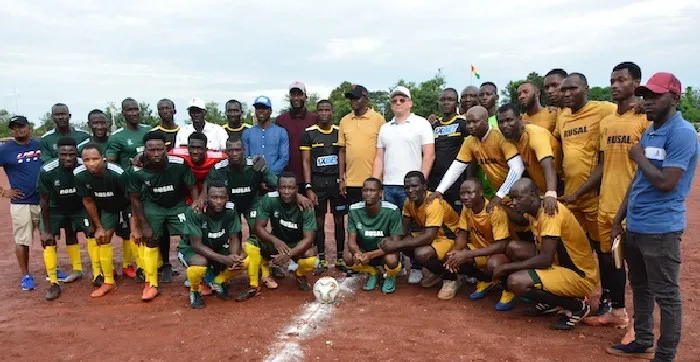
Fria, Guinea – RUSAL/Friguia's second annual football tournament, held from November 8-16, 2025, exemplifies how strategic community engagement can transform mining operations from purely industrial entities into integral community partners. The tournament, which has rapidly evolved into an anticipated annual tradition, offers valuable insights for mining companies seeking to enhance their Corporate Social Responsibility (CSR) frameworks in African jurisdictions.
Strategic Community Integration Through Sport
The tournament, named after General Director Aleksey Sakhachev, gathered eight teams representing both RUSAL/Friguia employees and Fria community members at Konko Sylla Stadium. Five teams comprised workers from various operational departments including Maintenance, Production, Administration, Railway, and Mining Works, while three teams represented local stakeholders: local media, the Fria Teachers Association (ASEF), and the Fria Football Coaches Association. This deliberate structural approach demonstrates how mining companies can create platforms that bridge the traditional divide between industrial operations and host communities.
The opening ceremony on November 8 drew significant participation from both corporate leadership and local government officials, including Prefect Colonel Alpha Oumar Cissé, underscoring the event's importance in fostering public-private partnerships. The inaugural match between RUSAL's Maintenance team and local journalists, which ended 2-0 in favor of the former, set an enthusiastic tone for the week-long competition.
CSR Analysis: Beyond Compliance to Community Investment
RUSAL/Friguia's approach represents a sophisticated evolution in mining sector CSR strategy. Rather than limiting engagement to mandatory compliance or one-off philanthropic gestures, the company has established recurring platforms for meaningful interaction. This model addresses several critical CSR objectives simultaneously:
Social License to Operate: By creating annual traditions that involve both employees and community members, RUSAL reinforces its legitimacy as a long-term community stakeholder rather than a transient extractive presence. The enthusiastic public demand for the tournament's continuation following its inaugural success demonstrates genuine community buy-in.
Stakeholder Engagement: The inclusive team composition facilitates organic relationship-building across traditional boundaries. When maintenance workers compete alongside teachers and journalists, informal networks develop that can prove invaluable during operational challenges or community consultations.
Local Economic Impact: While the direct economic value of such events may seem modest compared to operational expenditures, tournaments stimulate local commerce through increased foot traffic, vendor opportunities, and hospitality services, creating multiplier effects throughout the local economy.
Integrated Development Approach
Prefect Cissé's remarks positioned the tournament within Guinea's national development vision, emphasizing unity, discipline, and collective responsibility. He specifically acknowledged RUSAL's concrete contributions including urban sanitation support, judo hall rehabilitation, and construction of a children's playground with youth training facilities. This official recognition validates the company's broader CSR portfolio and demonstrates alignment with governmental priorities—a critical success factor for mining operations in evolving regulatory environments.
RUSAL's multi-faceted approach reflects best practices in sustainable mining operations. The combination of sports programming, infrastructure development, and urban improvement projects addresses diverse community needs while building institutional relationships across multiple government levels. For mining companies operating in similar contexts, this integrated strategy offers a template for creating sustainable community partnerships.
Operational Context and Industry Leadership
As one of Guinea's largest international investors, RUSAL operates three major facilities: the Compagnie des Bauxites de Kindia (CBK), the Friguia alumina refinery, and the Compagnie des Bauxites de Dian-Dian (COBAD) in Boké region. The Friguia complex, managed by RUSAL since 2002 and privatized in 2006, represents a significant industrial asset with annual production capacity of 600,000 tonnes of alumina and 2.1 million tonnes of bauxite, employing 1,349 people and operating a 160-kilometer railway network.
This operational scale positions RUSAL as a major employer and economic contributor, amplifying both the company's potential community impact and its responsibility for social investment. The football tournament, when viewed against this industrial footprint, represents a relatively modest investment that yields disproportionate returns in community goodwill and social cohesion.
Key Insights for Mining Companies
Several actionable lessons emerge from RUSAL/Friguia's initiative:
First, consistency matters more than scale. Annual traditions create anticipation and institutional memory, embedding the company within community rhythms rather than appearing as an occasional visitor.
Second, inclusive design maximizes impact. By involving both employees and community members as participants rather than passive beneficiaries, the tournament generates genuine relationship-building opportunities.
Third, alignment with government priorities strengthens positioning. When CSR initiatives reflect national development objectives, companies gain valuable political capital while demonstrating responsible corporate citizenship.
Finally, integrated programming creates synergies. The tournament complements RUSAL's infrastructure investments, creating a holistic community engagement strategy that addresses both immediate social needs and long-term development requirements.
As mining companies worldwide face increasing scrutiny regarding their social and environmental performance, RUSAL/Friguia's approach demonstrates that thoughtful, sustained community engagement can transform potential friction points into partnership opportunities, ultimately contributing to operational sustainability and license retention.